
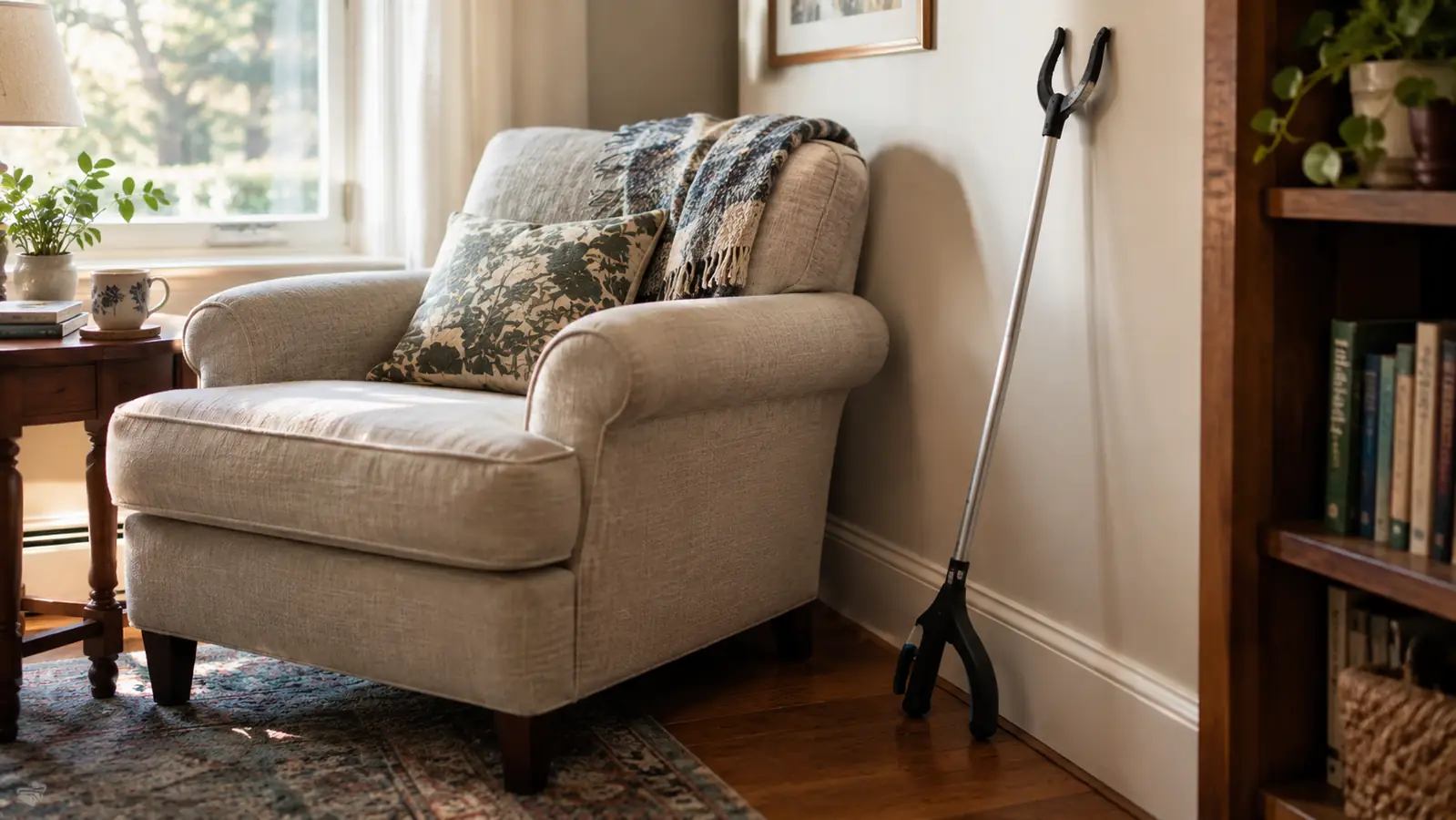
It usually starts with something small. A sock. The TV remote. A tube of lotion that rolls off the nightstand. You look at it on the floor, and then you have the conversation with yourself. Is it worth the bend? Can I get back up easily? Should I call for Gene? Most days I answered no, and the thing stayed there until one of us needed it badly enough.
That is the negotiation a reacher grabber ends. I bought a ZAYAD reacher last year after my physical therapist suggested I stop testing my knees on every dropped object. It now hangs by the back door, and I use it more than any other aid in the house. This is how I learned to use it well, what surprised me, and where I still put it down and bend anyway.
End the floor negotiation today
A reacher grabber turns a dropped item into a five-second pickup with no bending and no decision. The ZAYAD model I use has a 32-inch reach and a trigger grip that is easy on arthritic hands.
Amazon Check Today's Price on Amazon →Step 1: Choose the right reacher for your hands and your home
Not all reachers are the same, and the differences matter more than you would think. The first thing to check is the grip. Some reachers use a scissor-style handle that you squeeze with your whole hand. Others use a trigger you pull with one or two fingers. The trigger style is the one I prefer, because I have arthritis in both knees and my hands are not what they used to be either. A trigger that responds to a light pull means I actually use the tool instead of avoiding it.
The second thing to check is reach. The ZAYAD I bought is a 32-inch model, and that length handles almost everything I drop on the floor without making me lean forward. Before I bought it, I measured the distance from my shoulder to the floor while standing normally, and it came out to about 30 inches. That is why the 32-inch handle works for me. When I tried a 24-inch reacher at a neighbour's house last spring, I had to bend at the waist to reach the floor, and that bend is exactly what I was trying to avoid. I can stand tall with my feet planted and the jaws still reach the laminate in the kitchen. A longer reacher can reach farther, but it also weighs more and feels clumsier in a tight hallway. A shorter one is easier to store but means more bending when you use it. If you are mostly picking things up off the floor, 30 to 32 inches is a good middle ground.
The third thing is the handle and the jaws. The handle should feel comfortable in your hand for the two minutes it takes to do a small pickup. The jaws are the two ends that do the grabbing, and they should have a grippy surface so items do not slide out. If you can, try a reacher in person before you buy, or at least read reviews from people with similar hand strength. A stiff trigger is the most common complaint I see, and it is a fair one. The trigger on my ZAYAD is smooth and does not take much pressure, which is exactly what I needed.
Step 2: Get the grip right before you need it
The mechanism is simple. You pull the trigger, the jaws close, and the item is caught between them. Let go of the trigger and the jaws open. But there is a difference between understanding that and having the motion feel natural, so I recommend practicing before something important rolls under the sofa.
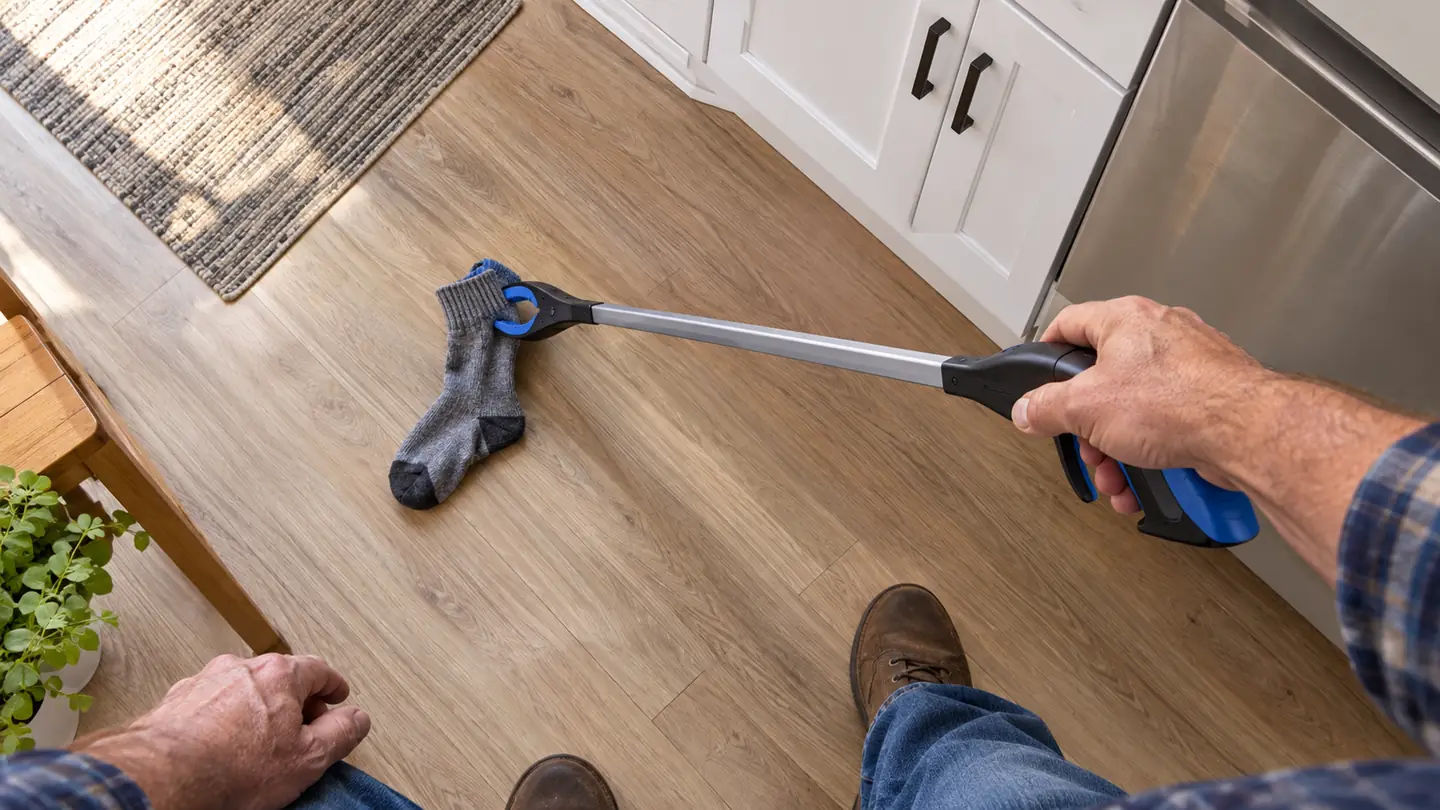
Start with something forgiving. A sock is the perfect first try. Lay it flat on the floor, position the open jaws around the middle of it, pull the trigger gently, and lift. The sock should come up with you. Then carry it to where you need it, hover over the spot, and release the trigger. That whole sequence takes about five seconds, and none of it requires bending. The first time I tried it, on a Tuesday morning in March, I dropped the sock twice before it came up cleanly. The first drop happened because I grabbed it from the top and the fabric folded over the jaws. The second time I slid the jaws underneath the sock first, and it came up on the first try. That is the difference practice makes. Gene watched from the kitchen table and said nothing, which for him is the highest compliment.
One tip that helped me: do not squeeze the trigger as hard as you can. The jaws only need enough pressure to hold the item. If you squeeze too hard, small things can pop out sideways, and fabric can bunch up and slip. A light, steady pull gives you more control. Also, keep your wrist straight and let the length of the tool do the reaching. You are not trying to lift with your arm; you are trying to grip and carry.
Step 3: Learn what it picks up well and what needs a different approach
After a few weeks, I got a sense of what the reacher handles beautifully and what still needs a workaround. Socks, slippers, washcloths, and most fabric items are easy. They are forgiving, and the jaws hold them without any fuss. Paper and mail are trickier because they are thin and floppy. I found that picking up a single sheet works better if I slide the jaws underneath it first, then grip, rather than trying to grab it from the top.
Small items like a dropped pill, a button, or a hearing aid battery take a different touch. For those, I line up the jaws carefully, pull the trigger very slowly, and lift straight up without any sideways motion. If the item is round, like a pill, it can roll the moment the jaws touch it. Easing the jaws around it first helps. Last month I dropped a blood pressure pill on the kitchen floor, and it rolled under the edge of the cabinet before I could reach it. I used the reacher to pull it out gently, then lined up the jaws and lifted it straight up. It took about ten seconds, and I never got down on the floor. The ZAYAD also has a small magnet in the tip, which I did not expect, and it has saved me from bending for a dropped screw and a sewing pin more than once. In June I dropped a sewing needle in the bedroom, and I swept the magnet across the carpet until I heard it click. Both of those would have been a knee-down job before.
For anything wedged under furniture, do not try to force it. Use the reacher to pull the item toward you first, then grip it once it is in the open. That two-step approach works much better than stabbing at it. Last winter a pen rolled under the sofa in the living room, and I slid the reacher in flat, hooked the edge of the pen, and pulled it toward me until I could grip it properly. Two moves, no bending, and the pen was back on the end table in under a minute. And if an item is heavy, like a full grocery bag or a jug of water, put the reacher down. It is a grip tool, not a lifting tool, and knowing that boundary is part of using it well.
Step 4: Make it a habit by keeping it where you drop things
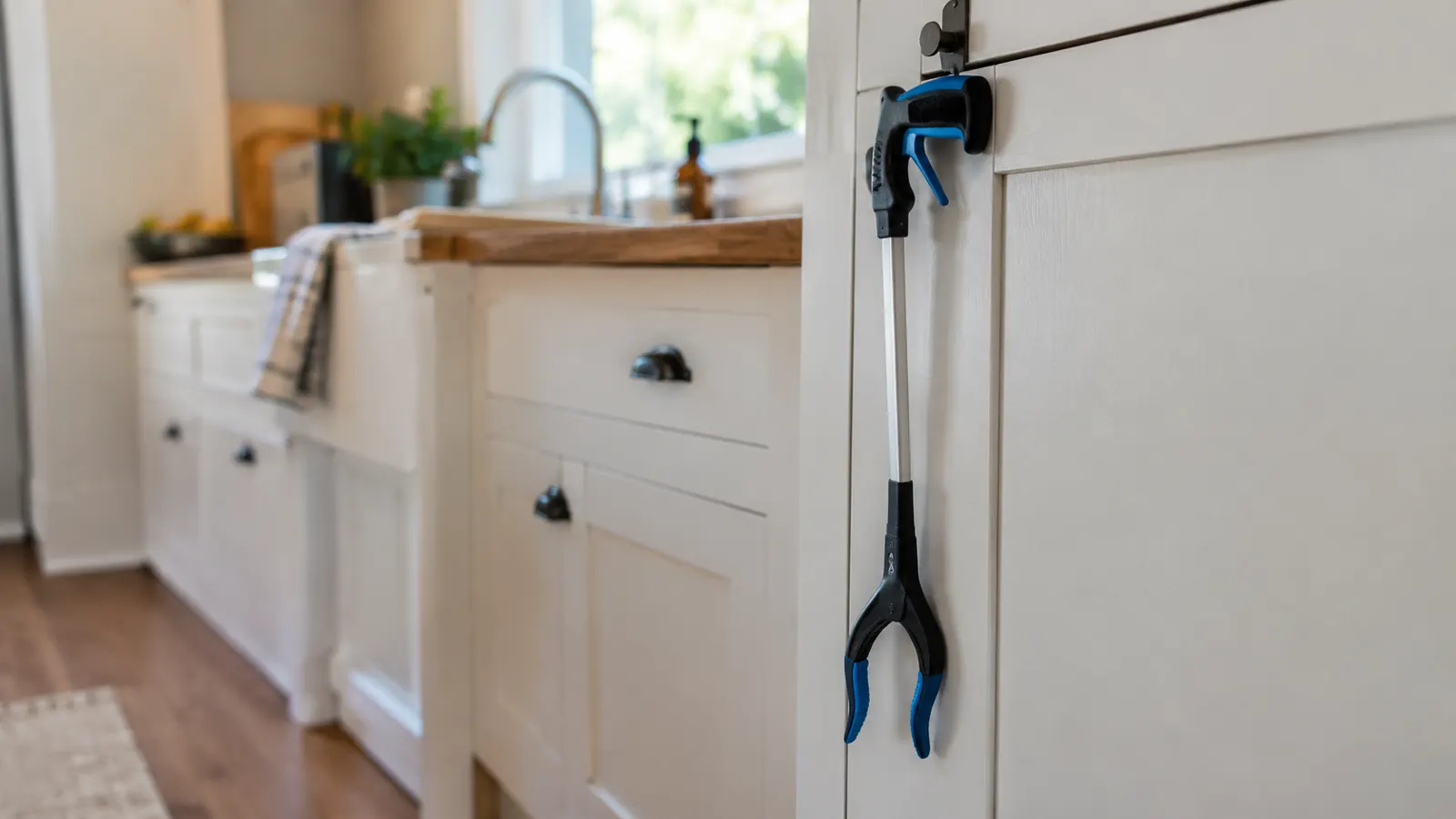
The best reacher in the world is useless if it is in the hall closet when you need it in the kitchen. The habit change that made the biggest difference for me was simple: I stopped storing the ZAYAD in one place and started keeping it where my day actually happens. There is one by my chair in the living room, one in the kitchen, and one in the bedroom. That sounds like overkill, but it is the difference between using it and not using it.
The ZAYAD has a small loop at the end of the handle, which makes it easy to hang on a hook or a cabinet knob. Hanging it keeps it visible and out of the way at the same time. I put a small hook on the inside of the pantry door on a Sunday afternoon, and that is where the kitchen one lives. The bedroom one stays on the floor beside my nightstand, because that is where my glasses land when I reach for them in the dark. When something drops, I reach for the tool before I even think about bending. I noticed the change on a Friday morning when I dropped a spoon while making coffee and picked it up without thinking about it. I did not even register that I had used the reacher until the spoon was back on the counter. That was the moment it became a habit instead of a chore.
There is also a social benefit I did not expect. Gene has had a knee replacement, and he used to be the one who picked things up for me. Now I can handle a dropped item myself in the time it takes him to turn around. It is a small independence, but it matters. I wrote more about the long-term experience in my full ZAYAD reacher review, including how it has held up after months of daily use.
Step 5: Know what it cannot do, and do not push it
A reacher is a wonderful tool, but it is not a replacement for all bending, and it is not a piece of medical equipment. It will not help you get up off the floor if you fall, and it should never be used as a walking aid or to pull yourself up from a chair. It is not built for that kind of weight, and using it that way is how handles break. If you are recovering from surgery or a fall, talk to your doctor or physical therapist before relying on any aid.
It also has limits with certain items. Anything very heavy, anything with an awkward shape like a full laundry basket, and anything fragile like a glass that might shatter if the jaws squeeze too hard are all better handled by hand. And while the reacher is great for the floor, it is not the right tool for high shelves. For those, I use a sturdy step stool, and I am careful about it.
The honest version is this: I still bend for some things. I bend for the heavy stuff, and I bend when I am already down in the garden. But the number of times I have chosen to leave something on the floor has dropped to almost zero. That is the real measure of whether the tool works. If you want to compare options before you buy, I compared the ZAYAD against a long-handled grabber in a separate article, because they are not the same tool.
What Else Helps
A reacher does its job well, but a few other inexpensive aids make the whole house easier. A sock aid helps with the morning struggle of putting on socks without bending. A long-handled shoe horn saves my back every time I wear anything with a heel. And a small, sturdy step stool with a handle is the right answer for high cabinets, as long as you use it carefully. None of these replace the reacher, and the reacher does not replace them. They work together, and together they mean I spend a lot less time thinking about my knees and a lot more time doing what I want to do.
The moment I stopped deciding whether to pick something up was the moment the reacher became worth every penny.
The last time you have to choose between bending and leaving it
A reacher grabber turns a daily negotiation into a five-second pickup. The ZAYAD model I have used for months is light, easy on the hands, and long enough to reach the floor without leaning.
Amazon Check Today's Price on Amazon →