
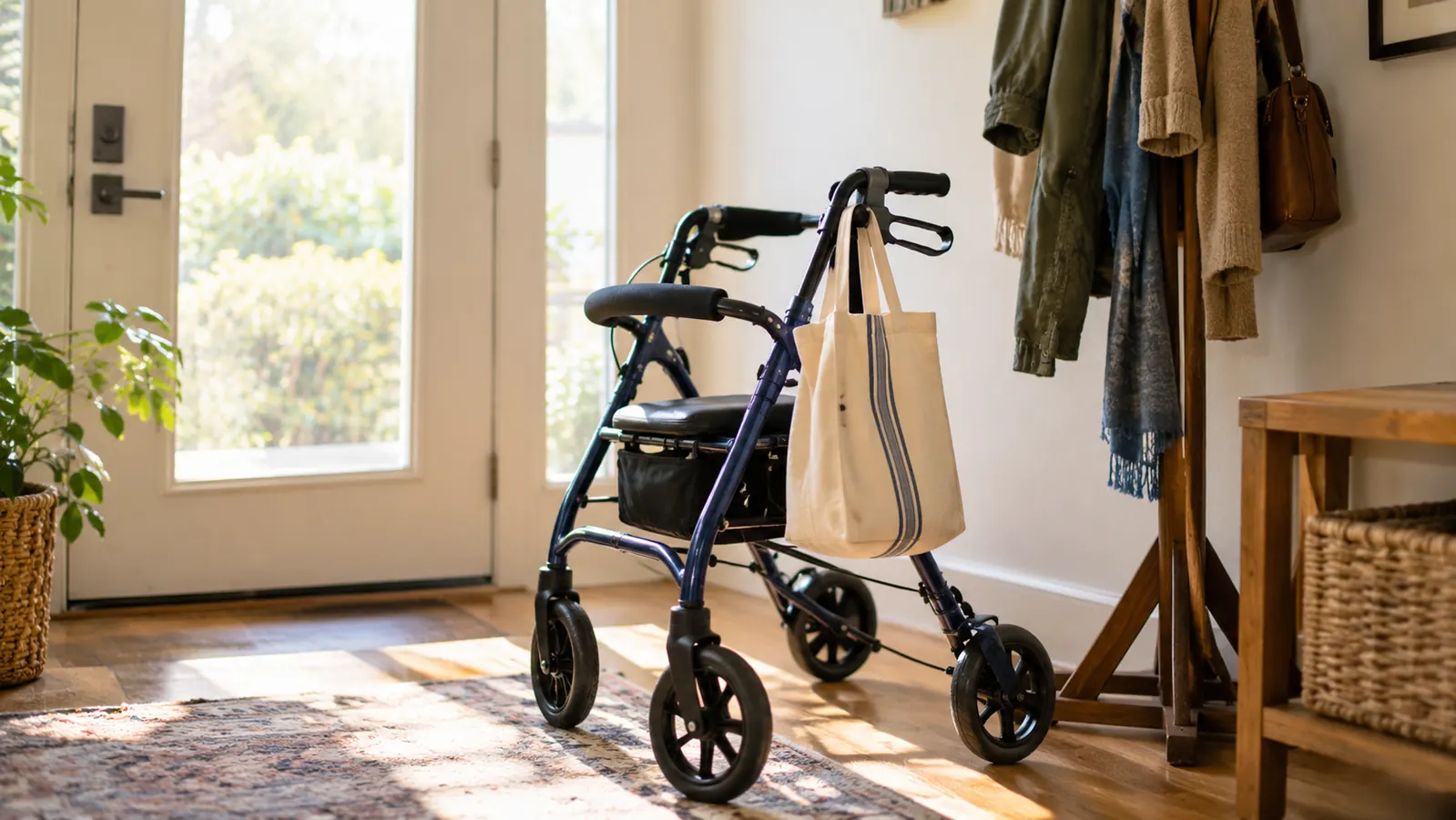
The Drive Medical rollator with 7.5 inch wheels has been parked in our front hall for the better part of a year now, and it has earned its spot. My husband Gene had a knee replacement two years ago, and I have mild arthritis in both knees and one hip, so we bought this rollator for the days when one of us needs a little extra steadiness. It gets used almost daily, sometimes by Gene on the way to the mailbox, sometimes by me when my hip acts up after chair yoga. I want to tell you how it actually holds up, because the listing photos do not show you what it feels like to live with one.
This is a long-term review, not a first impression. I have pushed it across laminate, rolled it over the lip of our front porch, folded it into our sedan trunk a few dozen times, and parked it beside the kitchen table while I cooked. It has been knocked over once, caught on a rug corner more times than I can count, and used as a seat while I waited for Gene at the pharmacy. Here is what I would want to know before I bought one.
The Quick Verdict
A sturdy, easy-to-roll walker with a seat that has handled daily use in our one-story home for months. The brakes take getting used to and the basket is small, but for the price it is the most dependable rollator we tried.
Amazon Check Today's Price →The rollator that has held up to daily use in our home
After months of pushing, folding, and sitting on this rollator, it is still the one we reach for first. Check today's price on Amazon and see if it fits your routine.
Amazon Check Today's Price on Amazon →How I've Used It
Our house is a one-story ranch outside Columbus, Ohio, with carpet in the bedrooms and laminate in the kitchen. That matters more than you would think. On carpet, this rollator rolls forward with a steady push and does not snag the way the tennis-ball walkers we borrowed from the hospital did. On laminate, it glides almost too easily, and I learned to keep a light grip on the brakes when I moved from the kitchen to the hallway.
I used it most on my afternoon walks. I do about twenty minutes of chair yoga most mornings, and on the days my hip complains, I take the rollator instead of my usual walking stick. The 7.5 inch wheels handled the sidewalk cracks and the gravel near our mailbox better than I expected. One afternoon I timed myself to the corner and back, and I finished two minutes faster than I did with my walking stick on the same route. The front wheels swivel, which makes turning around in our narrow hallway simple, but it also means the rollator wants to wander if you set it down without locking the brakes. I learned that the hard way when it rolled two feet across the kitchen and bumped the cabinet.
Gene used it differently. After his knee replacement, he needed something to lean on while standing at the counter, and the rollator let him do that without hunching over a cane. He also used the seat at the pharmacy and at the garden center while I browsed. The seat is firm, not padded like a chair, but it is fine for a five-minute rest. We both found the backrest too low to lean against properly, so we treat the seat as a perch, not a lounge chair.
One morning in early March, my hip was stiff enough that I nearly skipped my walk. Instead, I took the rollator out to the mailbox, which is about sixty yards down our gravel path. The front wheels handled the gravel without catching, and I made it back inside without the hip pain I expected. That was the day I stopped thinking of the rollator as Gene's and started thinking of it as ours. I also learned to keep a small bottle of water in the basket, because the seat is more comfortable when you are not reaching for a drink.
What the Drive Medical Rollator Does Well
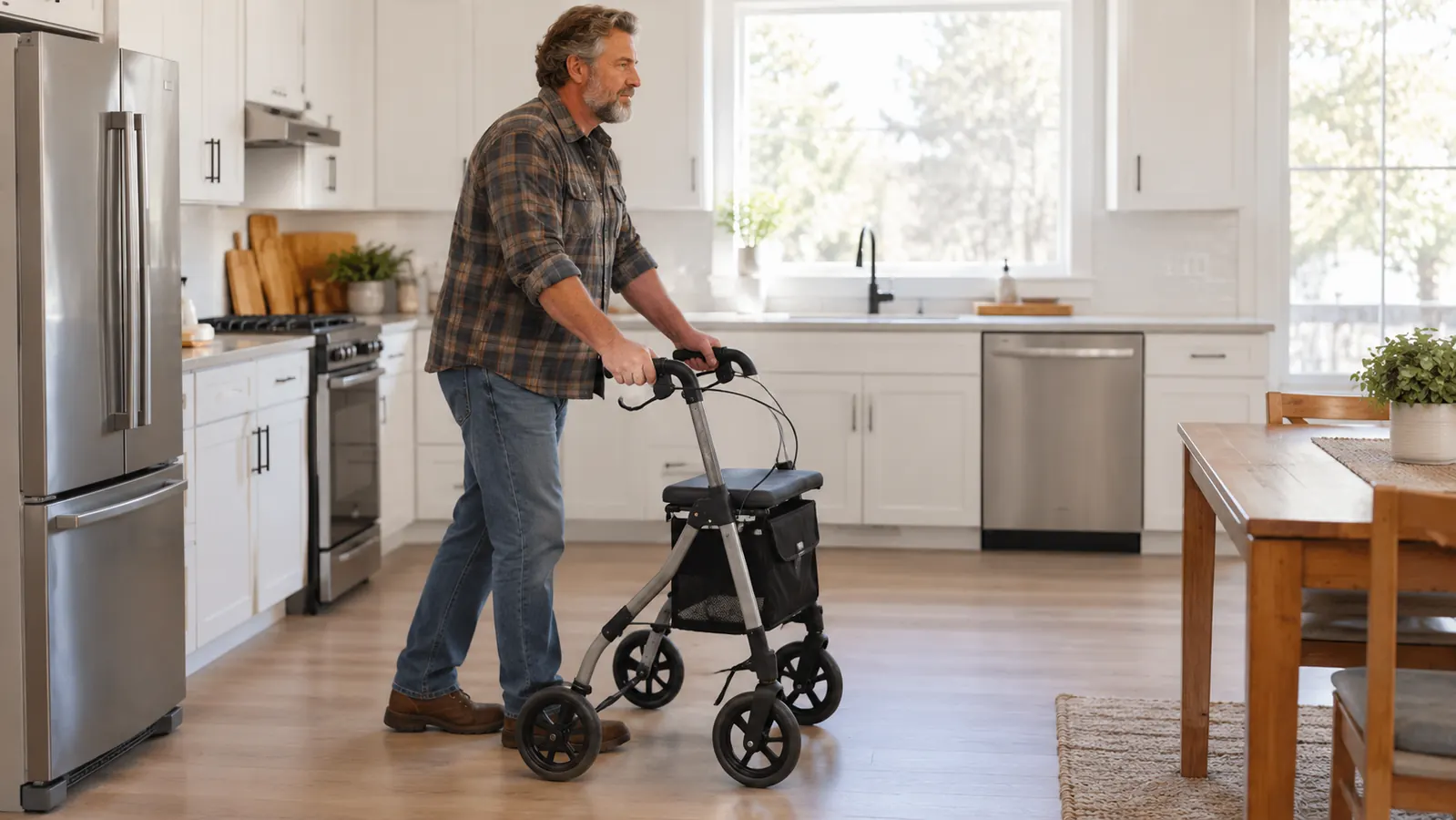
The first thing I noticed was how easy it is to push. The 7.5 inch wheels are larger than the wheels on the standard walker we borrowed, and that difference shows up on every sidewalk crack and threshold. I did not have to lift the front end over the lip of our porch the way I did with the hospital-style walker. I just tilted it back slightly and rolled it through.
The frame has held up well. After months of daily use, the crossbars are still tight, the handles have not loosened, and the wheels have not developed a wobble. I checked the screws under the seat after the first month and none of them had worked loose. I folded it into the trunk of our sedan at least twice a week to go to the grocery store or the library, and the folding mechanism still clicks into place cleanly. That matters, because a rollator that fights you when you fold it will end up living in the garage.
The braking system is a loop-lock style, which means you squeeze the handles to slow down and push down to lock. It took me a full week to remember which motion did what. On a cool morning in April, my fingers were stiff and I had to squeeze twice before the rollator slowed, but it did slow. Once I got it, though, the brakes felt secure. I can lock the rollator in place and sit down without worrying that it will roll out from under me. That is the most important safety feature on any rollator, and this one does it well.
The seat height adjusts, and that made a real difference for us. Gene is 76 and a few inches taller than I am, so we set the seat to his height when he uses it and lower it for me. The adjustment takes about a minute with the included tools. It is not something you want to do every day, but it is simple enough to switch between users.
I marked the frame with a small piece of tape at my usual setting, so I do not have to count holes every time we switch. Gene knows his setting by feel now, and the whole swap takes less than a minute. That sounds like a small thing, but when your hands are stiff in the morning, it is the difference between using the rollator and leaving it in the hall.
Where It Falls Short
The basket is small. I can fit a small purse, a library book, and a bag of birdseed, but not much else. I measured it against a half-gallon milk jug and it just fits, but there is no room to spare. A full grocery run means hanging bags from the handles, which changes the balance and makes the rollator harder to steer. I learned to keep the handles clear and carry a tote on my shoulder instead.
The backrest is too low to be truly useful. When I sat down to rest, I found myself arching my back to reach it, which defeated the purpose of sitting. Gene had the same complaint. We ended up using the seat for quick rests and standing up again before we actually felt relaxed.
The swivel wheels are both a strength and a shortcoming. They make turning easy in tight spaces, but they also make the rollator drift when you park it without locking the brakes. More than once I watched it glide a foot across the kitchen floor while I was reaching for something on the counter. You have to build the habit of locking the brakes every single time you stop.
The other shortcoming showed up on a rainy Tuesday. I hung a wet umbrella from the handle, and the rollator immediately felt top-heavy. I had to slow down and steer with both hands. Since then, I keep the handles clear and carry anything bulky in a tote. It is a small thing, but it is the kind of detail you only learn by living with the rollator for months.
What I Liked
- 7.5 inch wheels roll smoothly over sidewalk cracks and thresholds
- Folding mechanism is simple once you learn the motion
- Seat height adjusts quickly between two users
- Brakes lock securely, so the rollator stays put when you sit
- Frame has stayed tight after months of daily use
Where It Falls Short
- Basket is too small for a real grocery run
- Backrest is too low to lean against comfortably
- Swivel wheels drift if you forget to lock the brakes
- Loop-lock brakes take a firm squeeze, which may be hard for weak hands
After months of daily use, the frame is still tight, the wheels still roll true, and the brakes still hold. That is what I want from a rollator.
How It Compares to What We Tried Before
Before this rollator, we borrowed a standard walker from the hospital after Gene's knee replacement. It was the kind with no wheels that you lift and set down with every step. It worked, but it was slow and it tired Gene out. The Drive Medical rollator let him walk at a normal pace and stop to rest whenever he needed to, which made him more willing to actually use it.
We also looked at a rollator with 8 inch wheels at a local medical supply store. It rolled beautifully, but it was heavier and harder to lift into our trunk. The Drive Medical rollator weighs noticeably less, and for our needs, the smaller wheels were not a problem. If you plan to use your rollator mostly outdoors on rough terrain, the larger wheels might be worth the extra weight. For indoor use and neighborhood sidewalks, the 7.5 inch wheels are plenty.
The other thing I compared was the folding mechanism. Some rollators fold by pulling a cord in the middle of the seat, which I found awkward when my hands were full. The Drive Medical rollator folds by lifting the seat and pulling the sides together. It took me a few tries to get the motion right, but now I can fold it one-handed while holding a grocery bag with the other.
I also compared the Drive Medical rollator with a folding model that had a cord in the middle of the seat. The cord version folded smaller, but I could never get it to fold smoothly with one hand. The Drive Medical rollator takes a little more space in the trunk, but it folds with a motion I can do without thinking. For us, easy folding matters more than a few inches of trunk space.
Who This Is For
This rollator is for someone who wants to keep moving around their home and neighborhood without feeling like they are using a piece of medical equipment. It is light enough to lift into a car, narrow enough to fit through a standard doorway, and stable enough to lean on while standing at the kitchen counter. It is not a wheelchair, and it is not meant to be pushed while someone sits in it, but as a walking aid it has been dependable. If you have had a fall, a surgery, or a joint replacement and your doctor or physical therapist has cleared you to walk with a rollator, this is a good place to start.
It is also a good fit for a household with two people who share one rollator. The seat height adjustment is quick, and the frame has held up to being folded and unfolded by both of us. We are both in our seventies, and neither of us found it too heavy to manage.
In our house, the rollator lives by the front door, and we both reach for it without discussion. Gene uses it for the walk to the mailbox after dinner. I use it on days when chair yoga leaves my hip a little sore. A neighbor who had knee surgery last spring tried it on our porch and commented on how steady it felt. That is the best compliment I can give it.
Who Should Skip It
If you need a rollator for rough outdoor terrain, this is not the one. The 7.5 inch wheels handle sidewalks and packed gravel, but they will struggle on grass, dirt paths, and uneven trails. You would be better served by a rollator with larger wheels and a more rugged frame. If you plan to take it on a plane, check the folded size against your airline's rules before you buy.
If you are tall, the low backrest may bother you. Gene is 5'11" and he found the backrest useless for leaning back. If you plan to sit for more than a few minutes at a time, you may want a rollator with a higher backrest or a more padded seat.
And if you have limited hand strength, the loop-lock brakes might be a challenge. They require a firm squeeze to slow down and a deliberate push down to lock. My hands are still strong enough, but I can imagine someone with arthritis in their hands struggling with the motion. If that sounds like you, ask your physical therapist to show you a rollator with a different brake style before you buy.
If your home has thick carpet, test the wheels before you buy. Our bedroom carpet is low-pile and the rollator rolls over it fine, but a high-pile carpet can catch the front wheels. If you mostly walk on carpet, a rollator with smaller wheels might actually serve you better, or you may want to ask your physical therapist about a wheeled walker with a different design.
Still the rollator we reach for every single day
Months in, the Drive Medical rollator is still parked in our front hall, ready for the next walk. If you are comparing mobility aids, this is the one to check first.
Amazon Check Today's Price on Amazon →