
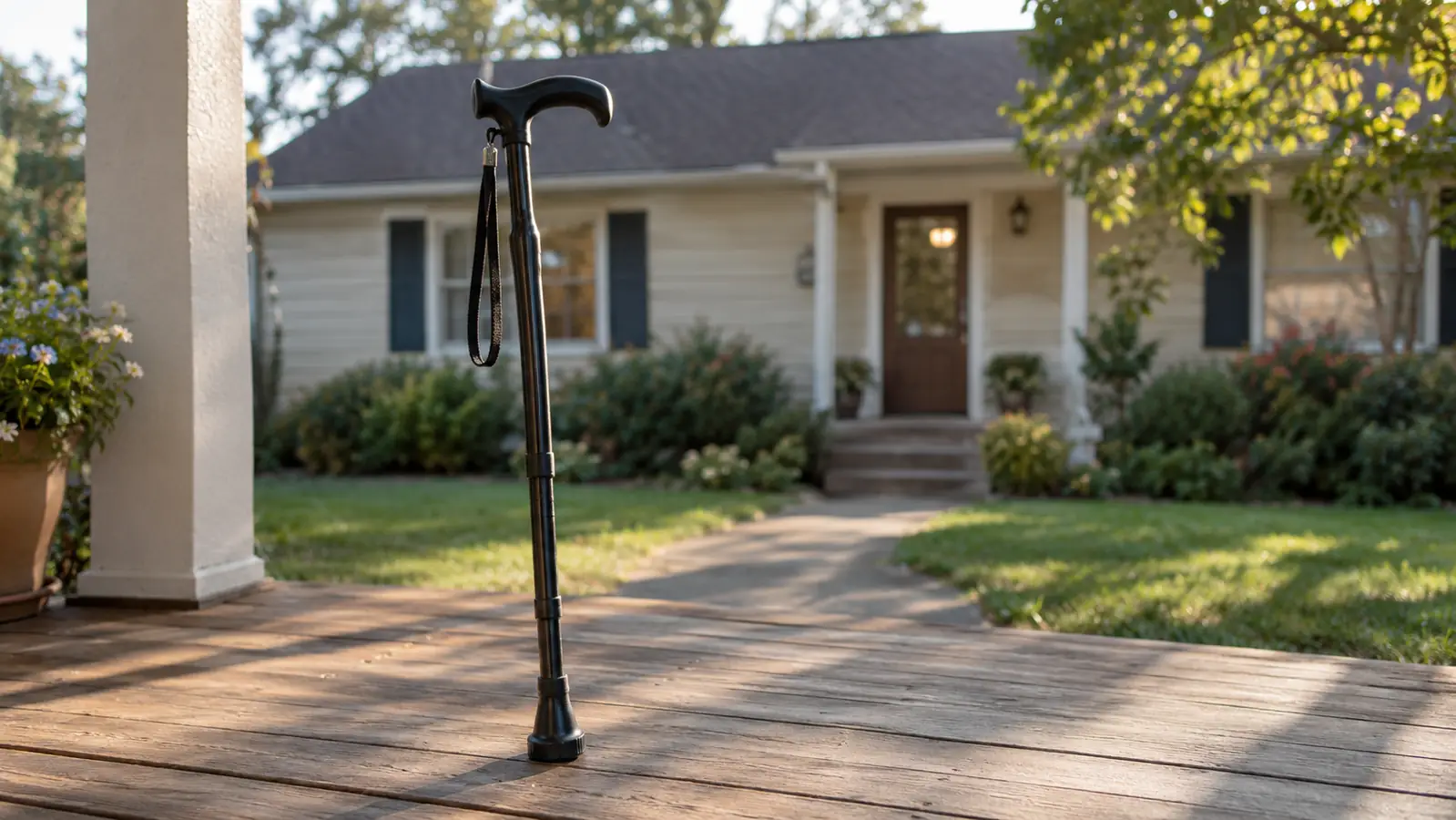
The first time I folded the HoneyBull cane, I pinched my thumb. Not hard enough to bruise, but hard enough that I said a word I do not usually say in the kitchen. That is the honest part of this review, and I want to lead with it, because most of what I read about this cane before we bought it made folding sound effortless. It is not effortless. It is learnable, and once you learn the motion it takes about five seconds. But nobody tells you about the pinch, or the practice, or how often you will reach for a cane you swore you would only use on bad days.
I am Lorraine Pettibone. I am 71, my husband Gene is 76, and he had a knee replacement two years ago. I have mild arthritis in both knees and one hip. We live in a one-story ranch house outside Columbus, Ohio, with three steps up to the front porch, carpet in the bedrooms, and laminate in the kitchen. I do a 20-minute chair yoga routine most mornings and I walk the neighborhood most afternoons. This cane has lived in our house for months now. I have used it on good days and bad days, at the grocery store, at the doctor's office, and for one very long day walking around the state fair. Here is what I wish someone had told me before I bought it.
The Quick Verdict
A folding cane that stands on its own and actually gets used, once you practice the fold. Not for anyone who needs heavy support, but for everyday steadiness it has earned a permanent spot by our front door.
Amazon Check Today's Price →The cane that stands up when you set it down
After months of daily use, the HoneyBull folding cane is the one we keep reaching for. It folds small enough for the car and stands on its own, so you are not bending to pick it up off the floor. Check today's price on Amazon to see if it fits your routine.
Amazon Check Today's Price on Amazon →How I've Used It
Gene came home from his knee replacement with a standard aluminum cane, the kind the hospital gives you. It did its job, and then it lived in the coat closet for a year and a half. That is the pattern with a lot of mobility aids. You use them when you have to, and the rest of the time they sit in a corner. I did not want that to happen with a cane I was buying for myself, so I looked for one that would solve the two problems that actually kept me from using a cane: it would not fit in the car nicely, and it would fall over the second I set it down.
The HoneyBull cane solves both of those. It folds into sections that fit in the trunk of our mid-size sedan, and it stands on its own when you set it down. Those two things sound like small details. They are not. They are the difference between a cane that gets used and a cane that stays in the closet.
Most days I use it for about a mile of my afternoon walk, especially when my hip is talking to me. Gene uses it when we go somewhere with a lot of standing, like the fair or a flea market. We share it, which I did not expect. It adjusts to both of our heights in a few seconds, and because it folds, it does not argue with the trunk of the car the way his hospital cane did.
What Nobody Tells You About Folding Canes
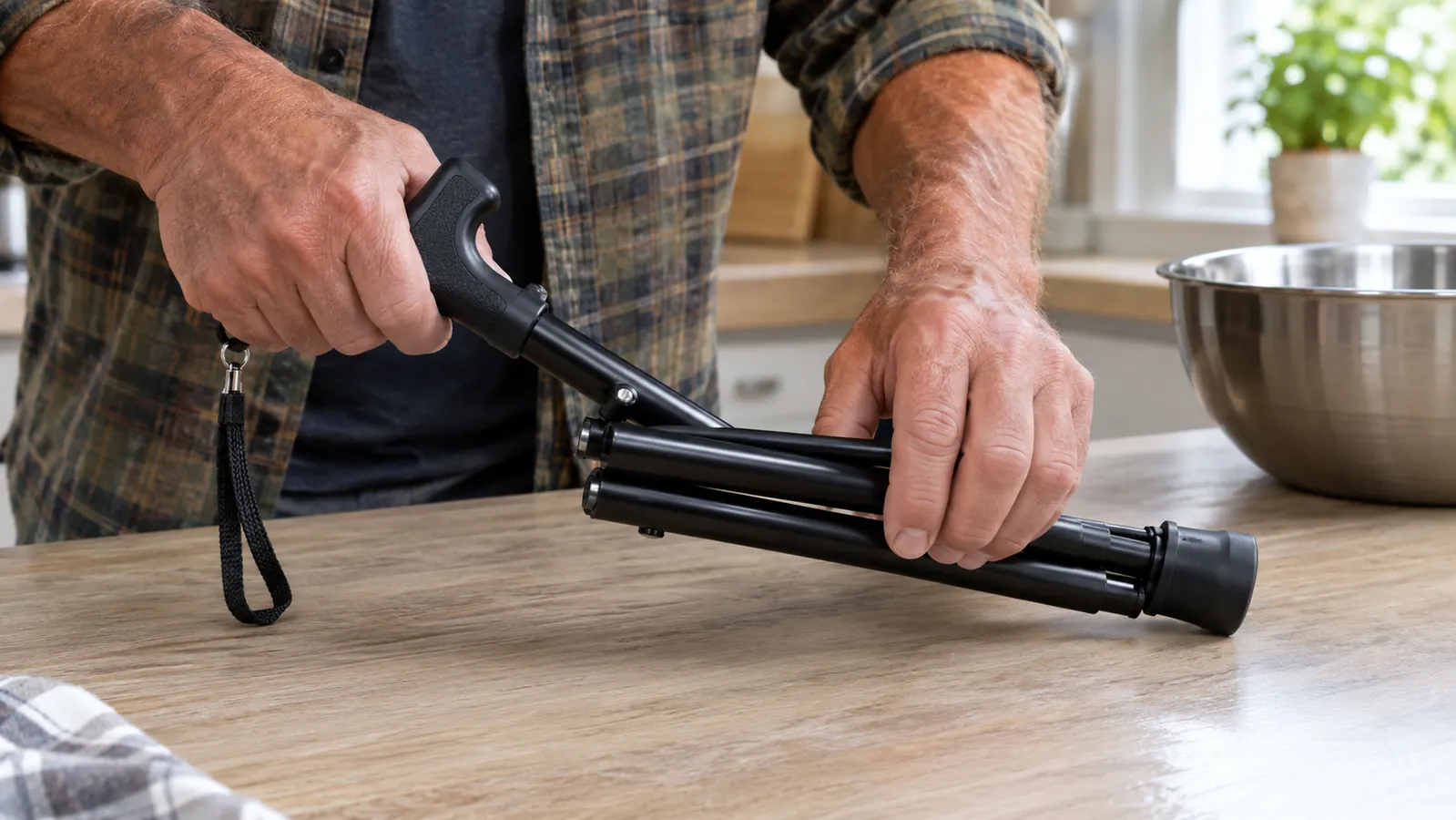
Let me start with the thing I almost returned it over. The first few times you fold this cane, it will fight you. The sections collapse like a tent pole, and if your fingers are in the wrong place when the sections come together, you will get pinched. I am not exaggerating when I say it took me a solid week of practicing in the living room before I could fold it without thinking. Gene still does it slowly, and he has less patience for it than I do. If you have arthritis in your hands or limited grip strength, this is a real consideration, not a small one.
The second thing nobody tells you is that a folding cane draws attention. People stop you in the grocery store to ask about it. At church, two different people asked Gene where he got it. Some people will love that, because it starts conversations. I am a retired librarian, so I do not mind talking to strangers. But if you are someone who wants to move through the world without being noticed, a cane that looks like clever gear is not the cane for you. A plain wooden cane disappears. This one does not.
The third thing is the base. Because this cane stands on its own, the base is wider than a regular cane tip. On our laminate kitchen floor it is wonderful. On the carpet in our bedroom, it catches on the edge of the rug if I do not lift it slightly when I walk. It has clipped a door frame more than once. You learn to adjust, but you should know going in that the feature that makes it stand up is also the feature that makes it slightly less graceful on thick carpet.
And the fourth thing is the weight. It is heavier than a simple wooden cane. Not heavy, but you notice it in a tote bag, and you notice it on a long walk. That weight is what makes the sections feel solid when they lock, so I consider it a fair trade. But I would rather tell you about it now than have you discover it on your first trip to the mailbox.
The Freestanding Base: The Feature I Didn't Know I Needed
I bought this cane for the folding. I kept it for the standing. It sounds silly to make a big deal out of a cane that stands up, but the older I get, the more I understand that bending down is the enemy. Every time I drop something or set something down too low, I have to decide whether it is worth the bend. A cane that falls off the table forces you to bend to pick it up, which is exactly the motion that makes my knees complain.
This cane stands up when you set it down. At the kitchen table, it stands beside my chair. At the doctor's office, it stands next to me instead of sliding off the exam table. At the fair, Gene set it down on the pavement and it just stood there while we ate a corn dog. I did not realize how much of my day was spent retrieving fallen canes until I did not have to anymore.
The tradeoff is real, and I want to be fair about it. The base that lets it stand is wider and less discreet than a single tip, and it can catch on things. But for us, the tradeoff is worth it a hundred times over. I would rather lift a cane slightly over a rug edge than bend down to the floor to pick it up.
The cane you will actually use is the one you do not have to bend over to pick up. Nobody told me that until I lived it.
Folding and Unfolding: Practice Before You Need It
Here is the advice I would give anyone who buys this cane: practice folding it before you need it. Not the day you need it, not the morning of. Practice it for a few days until the motion is in your hands. The cane opens into a straight, locked position and folds back down into sections. The first time you do it, you will be clumsy. The tenth time, you will not think about it.
I keep this cane in the car now, not in the house. That is the whole point of a folding cane for us. It lives in the trunk of our mid-size sedan, and it is there when we need it, whether we are going to the garden center or the pharmacy. Gene's hospital cane could not live in the car, because it was too long to fit without angling it across the back seat. This one folds down and tucks in next to the spare tire.
I will also tell you what I told a friend when she asked about it. If you have trouble with fine hand movements, or if you have had a stroke and only have reliable use of one hand, this is probably not the cane for you. Folding it takes two hands and a little patience. That is not a criticism of the cane. It is just the honest truth about how it works, and the kind of thing I wish someone had put in the product description.
How It Holds Up After Months of Use
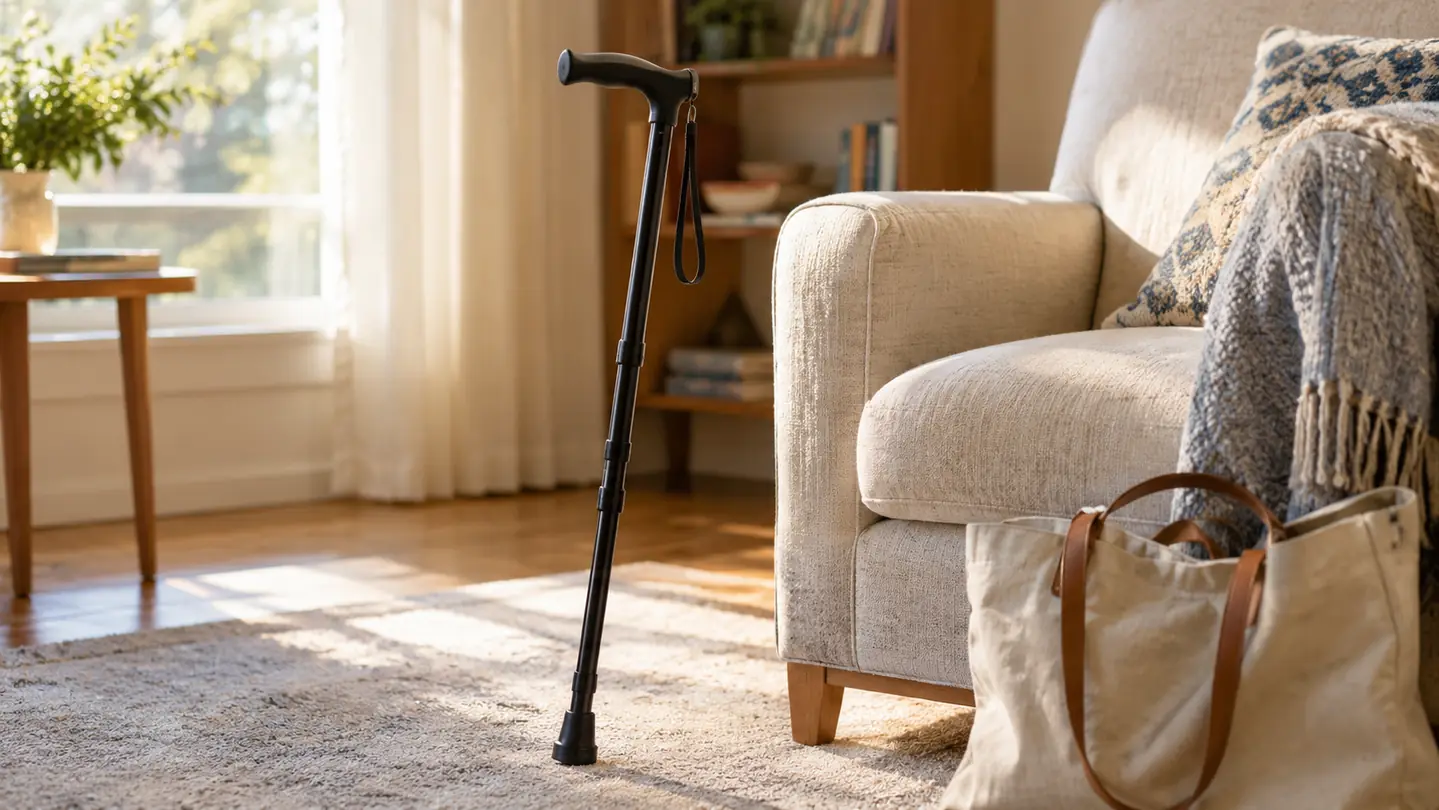
We have had this HoneyBull cane for months now, and it has held up better than I expected. The sections still lock tight. The base still stands square. The rubber tips on the bottom show some wear from pavement, but they still grip, and I have not had a single moment where the cane slipped on a wet floor. That matters to me, because a cane that slips is worse than no cane at all.
The handle is comfortable, but I want to be honest about the limits of any cane. After a two-mile walk, my hand gets tired no matter what I am holding. The handle on this one is wider than Gene's hospital cane, which helps, but it does not make my hand immune to fatigue. On days when my hip is stiff, I use the cane for the whole walk and switch hands at the halfway point. That small habit has kept me walking most afternoons, which is the real win.
The height adjustment is the one thing I would change if I could. It clicks into set positions, which makes it easy to switch between Gene and me, but it means you cannot fine-tune the height. Gene and I are different enough in height that we change the setting almost every time we swap, and the click makes it easy to find the right spot without fiddling. Most of the time the closest setting is fine. Every once in a while, I wish it sat half an inch higher. It is a small thing, but it is the kind of small thing you only learn by living with the cane for a while.
One more note on upkeep. The sections occasionally need a firm twist to seat them properly when I open the cane, and I wipe the handle down with a damp cloth now and then. That is the whole maintenance routine. There is nothing to oil and nothing to tighten, which is more than I can say for other folding gear we have owned over the years.
How It Compares to the Canes We've Tried
Gene's hospital cane is the easiest comparison, because we still have it in the coat closet. It is lighter than the HoneyBull, and it has a single tip that glides over carpet without catching. But it does not stand on its own, it does not fold, and it does not fit in the car without a fight. For us, the HoneyBull wins on the things that matter most: it is where we need it, and it does not end up on the floor.
I also tried a plain wooden cane that a neighbor let me borrow for a week. It is a beautiful cane, and I understand why people love them. But I did not take it anywhere, because it would not fit in the trunk and it rolls off the table. The honest lesson from our house is that the best cane is the one you actually carry with you. The HoneyBull is the one we carry.
What I Liked
- Stands on its own, so you are not bending down to pick it up
- Folds small enough to live in the car instead of the closet
- Easy to switch between two people of different heights
- Feels steadier than a single-point cane on uneven ground
- Gets used, which is the whole point of a mobility aid
Where It Falls Short
- Folding takes practice and can pinch until you learn the motion
- Wider base catches on carpet edges and door frames
- Heavier than a simple wooden cane
- Height adjusts in set positions, so you cannot fine-tune it
- Draws questions from strangers, which not everyone will want
Who This Is For
This cane is for people who need a little steadiness, not a lot of support. It is for people who are in and out of the car, people who travel, people who want a cane that can go to the fair and the pharmacy and a grandchild's graduation without being a production. It is for couples who can share one cane between them, the way Gene and I do. And it is for people who are a little embarrassed about needing a cane, because this one feels more like gear than like a medical device.
If you are choosing a cane after a fall or after surgery, please talk to your doctor or physical therapist first. I am not a medical professional, and I do not give medical advice. What I can tell you is what worked in our house: a cane that stands on its own, folds for the car, and gets used instead of ignored.
Who Should Skip It
If you need to put real weight on a cane, this is not the cane for you. It is a folding cane, not a heavy-duty support cane, and you should check the weight rating with the manufacturer and with your doctor before you rely on it. If you have limited hand strength, the folding mechanism will frustrate you. If you walk mostly on thick carpet, the base will catch on every rug edge. And if you want a cane that disappears into the background, this is not that cane either.
Gene and I are the right audience for this cane, and I can say that without pretending it is right for everyone. It solved our specific problems: the car, the bending, the closet. If those are not your problems, keep looking, and ask your physical therapist for a recommendation that matches your needs.
Try it on your own front porch
You can read every review on the internet, but the test that matters is whether the cane fits your hand, your door frames, and your trunk. The HoneyBull folding cane is the one we reach for daily. See today's price on Amazon and decide for yourself.
Amazon Check Today's Price on Amazon →