
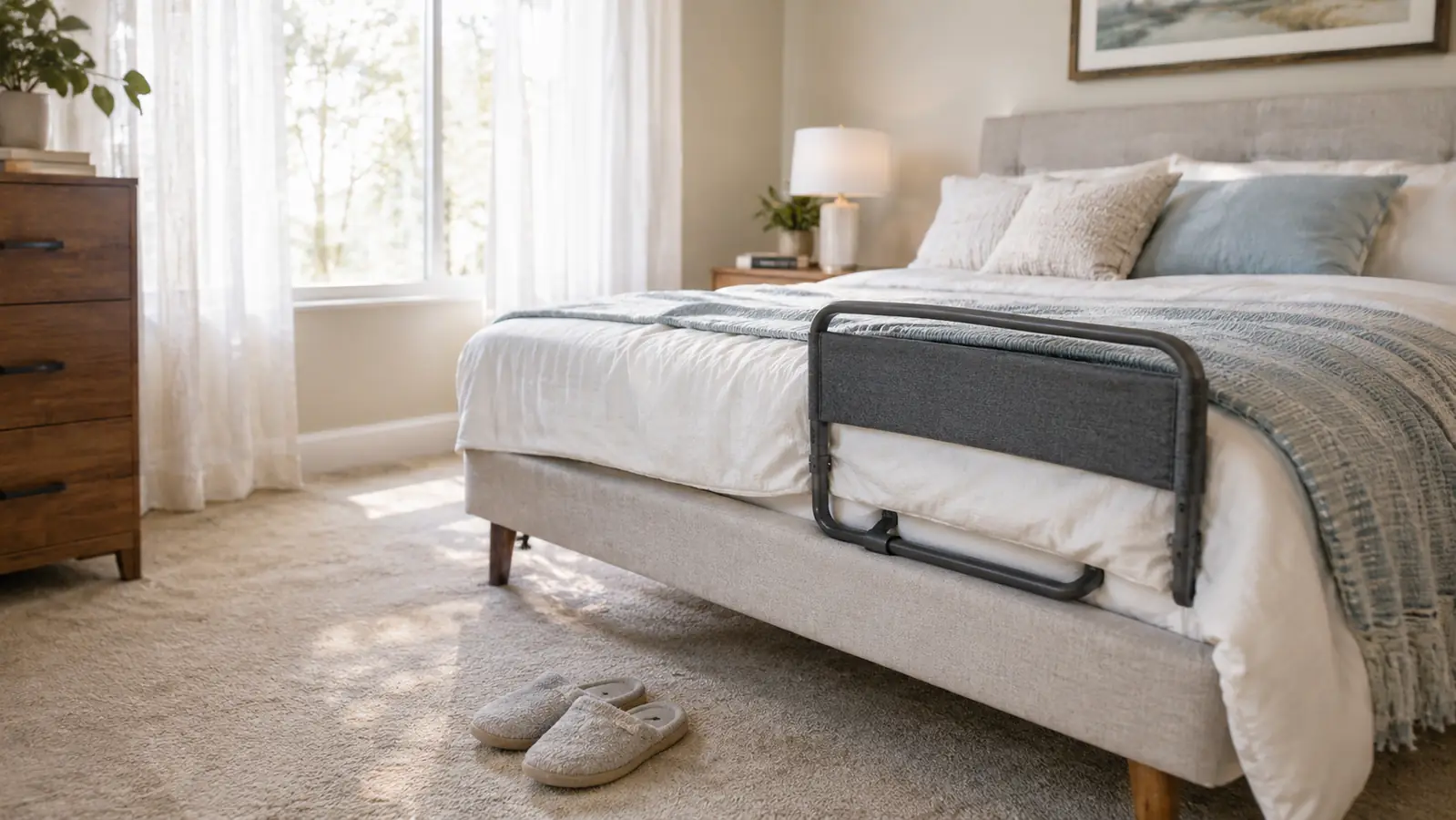
The hardest part of Gene's day is the first ten seconds after he wakes up. His knee, replaced two years ago, doesn't want to bend first thing in the morning, and the way our mattress sits, standing up from it takes a real pull. We tried a cane hooked over the nightstand. We tried a rope tied to the bed frame. We tried just being careful, which is what you say when you don't have a better answer. Then I ordered the Lunderg Bed Assist Rail, and after months of daily use in our one-story house outside Columbus, I can tell you exactly what it does and what it doesn't. We're both still active. Gene does his leg exercises every day, I do my chair yoga and my walks around the neighborhood. The rail isn't about giving up on any of that. It's about not having to think about the bed when you're half awake.
I'm Lorraine Pettibone, 71, a retired school librarian, and I've been testing this rail with my husband Gene, 76, since last fall. He uses it every morning and every night. I use it too on the days when my arthritis makes the first step out of bed more of a negotiation than a motion. This is the long-term review I wanted before I bought it: what it's like to live with, how it holds up, who should buy it, and who should think twice.
The Quick Verdict
A sturdy, low-profile bed rail that does one job well: it gives you something solid to pull on when you're getting out of bed and something to steady yourself against when you're getting back in. It won't lift you out of bed and it isn't a full hospital rail, but for daily support at home it has earned its spot beside our bed.
Amazon Check Today's Price →The rail we reach for every single morning
After months of daily use, the Lunderg Bed Assist Rail is still the first thing Gene grabs when his feet hit the floor. It slides under the mattress, needs no tools, and moves from one side of the bed to the other in about twenty seconds. Check today's price on Amazon and see if it fits your bed setup.
Amazon Check Today's Price on Amazon →How I've Used It
The rail lives on Gene's side of the bed, tucked between the mattress and the box spring. The flat base slides under the mattress edge, and the grab bar curves up over the top, so there's a handle waiting exactly where his hand lands when he rolls toward the edge. The first installation took me about four minutes, and I have never once needed a tool to adjust it since. Our bed is a standard frame with a box spring, and the rail seats itself without shifting. If you have a platform bed or a mattress directly on the floor, the way it fits will be different, so it's worth checking your setup.
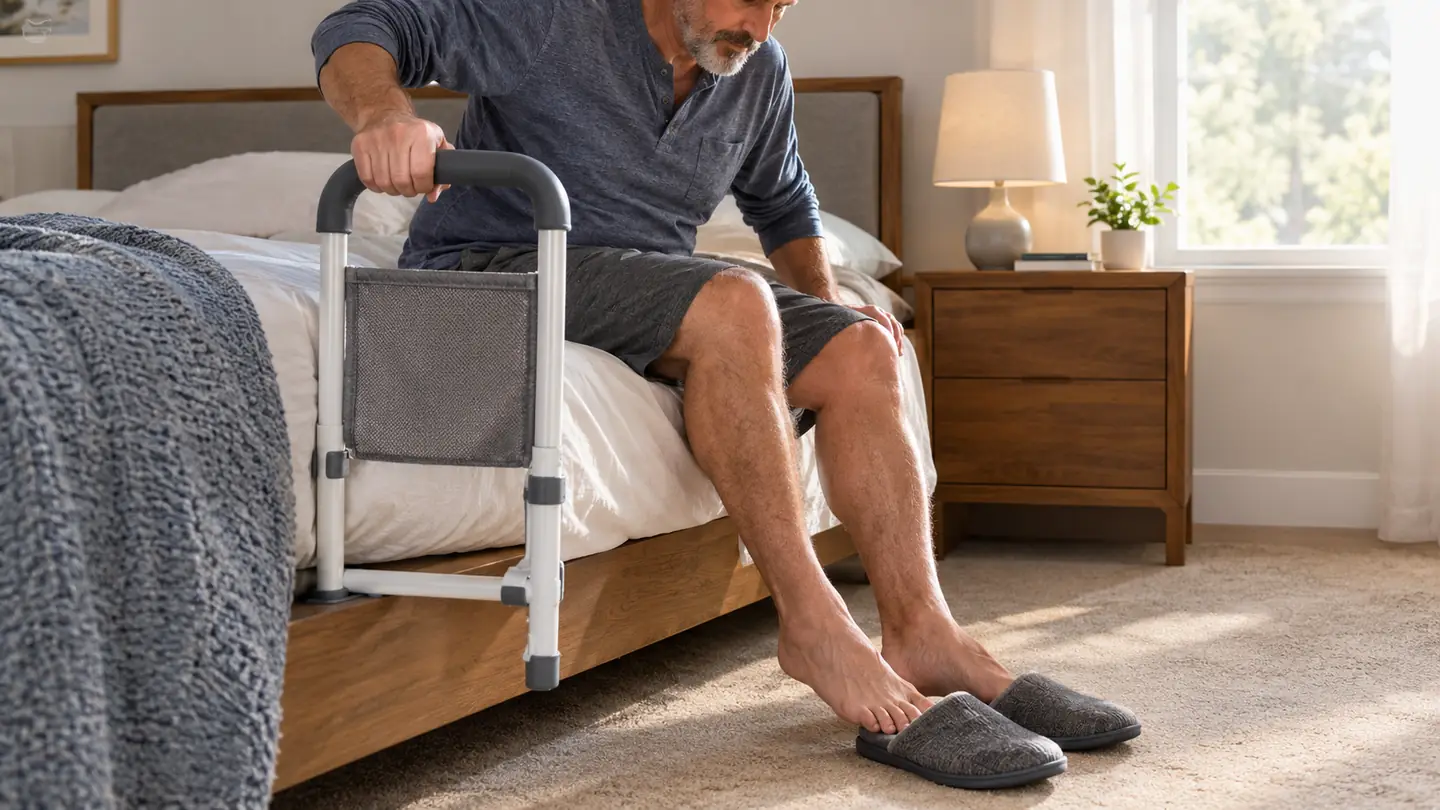
Morning is the real test. Gene wakes up, sits up, and uses the bar to pull himself the rest of the way to standing. The non-slip grip on the handle matters more than I expected. His hand is sometimes slick with sleep and lotion, and the textured surface gives him a purchase that a bare metal bar wouldn't. Getting back into bed, he uses it in reverse, holding the bar while he sits down, then swinging his legs up and settling back against the pillows.
I use it too, mostly on the days when my left hip is stiff. I don't need a rail on my side full time, but when I do need it, I can move the whole unit in about twenty seconds. That flexibility is the reason we didn't buy a second one. It's also the reason the rail has become part of our routine rather than a piece of equipment we keep meaning to use.
What the Rail Actually Does
A bed assist rail like this one solves a specific problem: the gap between lying down and standing up. It doesn't lift you. It doesn't push you. What it gives you is a fixed point to pull against, which is exactly what your legs need when they're not ready to do the whole job. For Gene, whose knee stiffness is worst in the first minutes of the day, that fixed point is the difference between a smooth rise and a lurch.
The Lunderg works by sliding its base under the mattress, so your body weight holds it in place. The handle rises above the mattress surface and sits close to the edge, which means it's within reach without stretching. That short reach matters more than you'd think. A handle that's six inches too far away might as well not be there at 6 a.m.
The non-slip grab bar is the feature I'd point to first. It's a textured grip along the top of the handle, and it stays grippy even when hands are clammy. That sounds like a small thing until you've watched someone's hand slide off a smooth rail in the dark. The grip is also easy to wipe clean, which I appreciate because the rail gets used a lot. The grip runs the full length of the handle, so Gene can grab it high or low depending on how he's positioned. That range matters more than you'd expect as the morning goes on.
How It's Held Up Over the Months
After months of daily use, the rail looks essentially the same as the day it arrived. The grip hasn't worn smooth. The base hasn't bent. It doesn't wobble when Gene puts his full weight on it, and it hasn't scratched the floor or the bed frame. For a piece of equipment that gets used twice a day, every day, that's the durability test that matters. I checked the screws and joints at the one-month mark and again at three months; everything was tight.
Cleaning has been simple. A damp cloth and mild soap handle the grip, and the metal frame wipes down in seconds. We have carpet in the bedroom, and the base sits on top of it without leaving permanent marks. When we changed the sheets last week, the rail stayed exactly where it was supposed to be.
One thing I learned the hard way: the rail holds best when the mattress is reasonably firm and the base is pushed fully under. On a very soft mattress, you'd want to check that it stays snug. Ours is a medium-firm mattress on a standard frame, and we've never had to re-tighten or reposition it. If your mattress is new and still settling, give it a few weeks before you judge the fit.
The Tradeoffs I Noticed
No piece of equipment is perfect, and this rail has honest limits. The first is that it's a support, not a lift. If you need help actually rising from a seated position, or if you're recovering from surgery and can't bear weight on one leg, a rail alone isn't enough. That's a conversation for your doctor or physical therapist, and it's the first thing I'd tell anyone considering this after a fall.
The second tradeoff is the reach. The handle sits at the edge of the mattress, so it works best if you sleep near the edge. Gene sleeps close to the side, so it's perfect for him. If you sleep in the middle of the bed, you'll find yourself reaching across the mattress, and the rail won't be as useful. Measure where you actually sleep before you commit.
The third is small but real: it's one more thing at the edge of the bed. At night, when the room is dark, you need to remember it's there. We've never tripped over ours because the base is flat and low, but I can see how someone with limited foot clearance might find it in the way. It's also not a grab bar for the bathroom, and it's not a step stool. It does one job, and it does it well.
One more thing to know: the rail doesn't change how high the bed sits. If your problem is that the bed is too low to get out of easily, a rail won't fix that. You'd be looking at a bed riser or a different mattress height, and that's a separate conversation.

Alternatives We Considered
Before we settled on the Lunderg, I looked at the other common options. Full hospital-style side rails attach to the bed frame and fold down when you don't need them. They offer more coverage, but they're heavier, more visible, and more of a project to install. For our needs, that was more rail than we wanted, and the bedroom started to feel like a hospital room.
Bed canes and floor-mounted handles take up floor space and can move on carpet. We also considered a rope or strap tied to the bed frame, which is what a lot of people try first. It works in a pinch, but it doesn't give you a rigid handle, and it can slip. The Lunderg sits between those options: more support than a strap, less machinery than a hospital rail.
I'll say plainly that I can't compare it to every brand on the market. What I can tell you is that this is the one we kept, the one that gets used every day, and the one I'd buy again. If you're deciding between a rail like this and doing nothing, I know which side of that decision I land on. And if you have a neighbor or a friend with a similar rail, ask to try it before you order. That's the one step I'd do differently if I had it to do over.
A Note on Getting It Right
The one piece of advice I'd give anyone setting this up: put the rail where your hand naturally lands, not where it looks best. We started with it positioned a few inches too far toward the headboard, and Gene had to reach back for it. Moving it two inches made the whole motion feel natural.
The other thing I'd say is to give it a week before you decide. The first few nights, a new rail can feel like an obstacle. By the end of the first week, it felt like part of the bed. Now I notice it's missing when we travel and there's nothing to grab.
And if you're buying this for someone else, involve them in the placement. Let them tell you where the handle needs to be. It's a small thing, but it's the difference between an aid that gets used and one that gets pushed to the side of the bed.
What I Liked
- Slides under the mattress with no tools and no permanent installation
- Non-slip grip on the handle stays grippy through months of daily use
- Solid and stable under full weight, with no wobble
- Easy to move from one side of the bed to the other in about twenty seconds
- Low profile that doesn't take up floor space or catch on the sheets
- Works with a standard bed frame and box spring without modification
Where It Falls Short
- A support, not a lift: it won't help you rise if you can't bear weight on your legs
- Handle reach works best if you sleep near the edge of the bed
- Holds best on a firmer mattress; very soft mattresses need a check
- One more thing at the edge of the bed to remember in the dark
- Not made for platform beds or mattresses on the floor without checking the fit
Months of twice-daily use, and the Lunderg still doesn't wobble when Gene puts his full weight on it. That's the durability test that matters.
Who This Is For
This rail is for someone who can stand on their own but wants something solid to hold while they get there. It's for the person who wakes up stiff, the person whose balance is a little less sure at 3 a.m., and the person who just wants an extra hand to grab in the dark. It's also for the caregiver who wants to make the bedroom safer without turning it into a medical ward. It's for the person who is tired of being careful. If that sounds like you or someone you care for, the Lunderg is a simple, honest answer.
Who Should Skip It
Skip it if you need help actually rising, if you're recovering from a fall or surgery and can't put weight on one leg, or if your care plan calls for a full side rail. That's not a failure of this product; it's a different job. Talk to your doctor or physical therapist about what your situation needs. And if your mattress is very soft, or you sleep in the middle of the bed, measure your setup before you order. The right aid is the one that matches your actual needs. And if you're not sure which camp you're in, that's exactly what your doctor or physical therapist is for.
Months later, it's still the first thing Gene reaches for
The Lunderg Bed Assist Rail has earned its place beside our bed through months of daily use. If you're weighing whether a bed assist rail will actually help, this is the one we kept. Check today's price on Amazon and see if it fits your bed setup.
Amazon Check Today's Price on Amazon →