
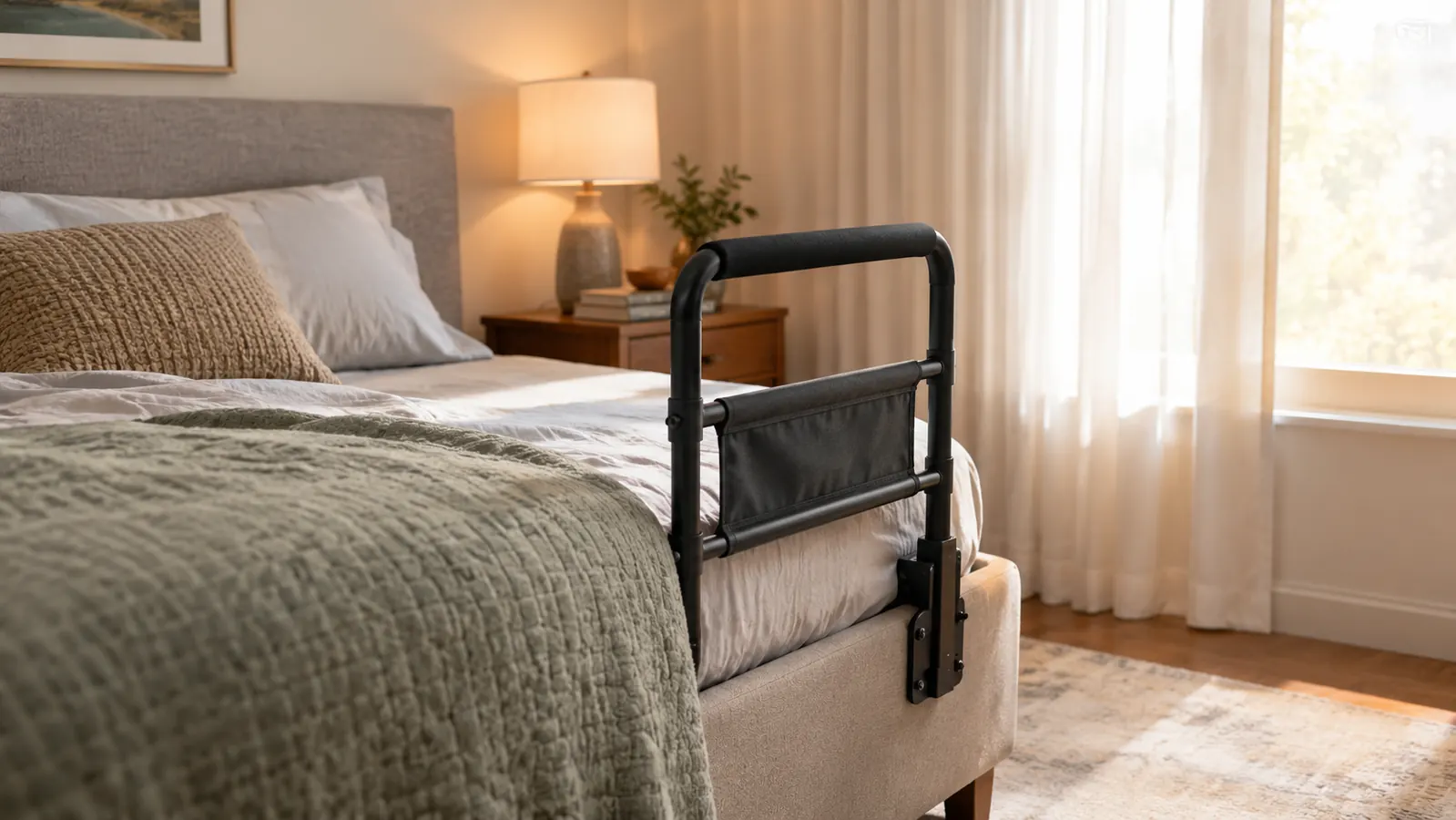
If you or someone you care for is waking up at night and dreading the trip to the bathroom, you have probably looked at two very different solutions. The Lunderg Bed Assist Rail for Seniors with Non-Slip Grab Bar slides under the mattress and gives you something solid to pull on. A hospital-style bed rail is the tall metal frame you see in care facilities, and it does a different job entirely. I tested both in my own home, and the honest answer is that one of them is right for most people, and the other is right for a much smaller group.
My name is Lorraine Pettibone. I am 71, I live with my husband Gene in a one-story ranch house outside Columbus, Ohio, and I have mild arthritis in both knees and one hip. Gene had a knee replacement two years ago. That means we have spent a lot of time thinking about how to get out of bed safely. Here is the short answer before I get into the details: for our house, our bed, and our bodies, the Lunderg rail won. But I will show you exactly where the hospital-style rail is the better choice, because for some people it genuinely is.
| Lunderg Bed Assist Rail | Hospital-Style Bed Rail | |
|---|---|---|
| What it does | Gives you a sturdy grab bar at mattress level to pull on while sitting up and getting out of bed | Tall metal side rail that keeps you from rolling out of bed, more like a safety barrier |
| Best for | People who can sit up on their own but need help with the final push to standing | People who roll in their sleep, are at high fall risk, or need a rail to keep them from getting out of bed unsupervised |
| Installation | Slides under the mattress, no tools, takes about five minutes | Usually bolts to the bed frame; some models need tools and a second person |
| Getting in and out of bed | Low profile, so you can sit on the edge of the bed and use the bar to stand | Tall rail can block the edge of the bed, so you may have to climb over it or lower it first |
| Safety for rolling out of bed | Not designed to stop a roll; it is a grab bar, not a barrier | Designed as a barrier, with a release latch so a caregiver can lower it |
| Comfort and grip | Padded non-slip grab bar, comfortable for an arthritic hand | Hard metal bar, usually not padded |
| Works with adjustable beds | Generally yes, when installed per the instructions | Some models work, but the tall rail can be awkward with a raised head |
| Price | A fraction of the cost of a full hospital rail | Often several times the price, especially with installation |
Where the Lunderg Rail Wins
The Lunderg Bed Assist Rail wins on the job most people actually need done. When Gene came home from his knee replacement, the hardest moment of his day was not the physical therapy. It was 2 a.m., when he needed to get up and the bed felt like a trap. The Lunderg rail slides under the mattress and gives him a padded, non-slip bar to grip. He can sit up, get his feet on the floor, and use the bar to pull himself the rest of the way. It took him about a day to stop reaching for the bedside table and start using the rail automatically.
Installation is the other big win. I put the Lunderg rail on our bed by myself in about five minutes, no tools, no second person. The rail sits low against the mattress, so it does not block the edge of the bed. That matters more than you might think. With a hospital-style rail, you sometimes have to climb over a tall bar to get in and out of bed. For someone with a freshly replaced knee, that is not a minor annoyance. It is a reason to avoid getting up at all, which is exactly the opposite of what you want after surgery.
Our bed is a queen, and the mattress sits about 22 inches off the floor, which sounds low until you are the one trying to get out of it at 2 a.m. The Lunderg rail anchors with a flat plate that slides between the mattress and the box spring, so the weight of the bed holds it in place. I tested it the first morning by leaning on the bar with most of my weight, and it did not shift a millimeter. The bar sits at hip level when Gene is sitting on the edge of the bed, and that turned out to be the whole difference. He can grip it while he is still lying down to pull himself upright, then grip it again once his feet are on the floor to make the final push to standing. Two different jobs, one bar, both at the right height. The hospital rail could not do either one, because its bar was up near his shoulder, which is a position for holding on, not for pulling yourself up. I have arthritis in both knees and one hip, so I know exactly what that pull feels like when your hands are the only thing between you and the floor.

Where the Hospital-Style Rail Wins
I will be honest with you. The hospital-style rail wins for one job, and it is an important one. If the person in the bed is at risk of rolling out during sleep, or if they are confused at night and might try to get up without help, a tall rail is the safer choice. It is a barrier. It keeps them in bed. The Lunderg rail is not designed to stop a roll, and you should not expect it to. For a caregiver, the hospital rail also has a release latch, so you can lower it to help someone in and out.
The hospital-style rail also wins for someone who needs a rail the full length of the bed, or who needs to reposition themselves in bed using a rail above them. That is a different movement than getting out of bed. If your physical therapist has told you to use a rail to turn or shift in bed, a tall rail gives you more to work with. In our case, neither Gene nor I needed that. We needed help with the transition from sitting to standing, and that is the Lunderg rail's job.
The hospital-style rail we tried came from a local medical supply company, and it took Gene and me about forty minutes to bolt it to the bed frame. I want to be fair to it, because it is a well-made piece of equipment and it does exactly what it claims to do. The model we had included a release latch on the outside, so I could lower the rail from my side of the bed to help Gene in and out. That is a genuine advantage for a caregiver, and I do not want to wave it away. But it came with a cost we did not expect. Gene could not lower the rail from his own side without reaching across his body, and once it was lowered, he still had to sit up and find something to push against. The rail solved the problem of staying in bed, but it did nothing for the problem of getting out. For someone whose only job is to keep a loved one safe through the night, that trade can be exactly right. It just was not right for us.
Need a hand getting out of bed tonight?
The Lunderg Bed Assist Rail gives you a padded, non-slip bar at mattress level, and it installs in about five minutes with no tools. For most people at home, this is the rail that actually gets used.
Amazon Check Today's Price on Amazon →Who Should Buy Which
Buy the Lunderg Bed Assist Rail if you can sit up on your own but want something sturdy to pull on for the final push to standing. Buy it if you have arthritis in your hands, because the padded grip is genuinely comfortable. Buy it if you are caring for someone who just had surgery and needs a little help at night without a big piece of equipment in the room.
Choose a hospital-style rail if the person in the bed is at high risk of rolling out, if a doctor or physical therapist has recommended a full barrier, or if you need a rail the full length of the bed for repositioning. And check with your doctor or physical therapist before you buy anything, especially after a fall or surgery. They may have specific advice for your situation that no article can give you.
The Lunderg rail wins for most people because it helps with the hardest moment, the transition from sitting to standing, without turning the bed into a piece of hospital equipment.

What I Learned Watching Gene Use Both
I set up the hospital-style rail first, because it looked like the more serious piece of equipment. Gene used it for a week. He appreciated that it kept him from rolling out of bed, but he hated climbing over it to get out. Every time he used it, he had to lower the rail, sit up, and then reach for the bedside table anyway, because the rail was too high to be a useful grab bar. It was doing a job he did not need done, and it was in the way of the job he did need done.
Then I swapped in the Lunderg rail. The difference showed up the first night. Gene could grip the padded bar, pull himself to sitting, and use the same bar to stand. He stopped reaching for the bedside table. He stopped asking me to come help him up. After two nights he said the bed finally felt like it was on his side. That is the whole point of a mobility aid. It should make you more independent, not more dependent on a caregiver.
The clearest moment came on a Thursday night, about ten days after Gene came home from the hospital. I woke at 2:15 to the sound of the bedside lamp clicking on, and then a thump that turned out to be his glass of water hitting the carpet. He had used the hospital rail to sit up, then let go of it and reached for the nightstand anyway, because the tall bar could not help him once his feet were on the floor. He was fine, just frustrated, but it showed me the problem in one image: the equipment in the room was not the equipment he needed. The night after I swapped in the Lunderg rail, he got up twice and I never heard either trip. He told me the next morning that he had used the padded bar both times without thinking about it. That is the test that matters to me. Not whether a product looks like it belongs in a hospital, but whether your hand finds it in the dark, without a lamp, without a reminder, when you are half awake and your knee is stiff. I have mild arthritis in my own knees, so I know that stiffness is not just an inconvenience at that hour; it is the reason people fall.
A Few Honest Notes on the Lunderg Rail
No product is perfect, and the Lunderg rail has limits. It is a grab bar, not a barrier. If you need to keep someone from rolling out of bed, this is not the tool for that job. It also works best on a bed with a solid frame. If your bed is very soft or very low, check the fit before you rely on it. And while it worked fine on our adjustable bed, I would test the installation with the head raised before you trust it at night.
One more thing I appreciate about the Lunderg rail is that it does not make the bedroom feel like a hospital room. That matters more than people admit. When you are recovering from surgery or managing arthritis, you want your home to feel like home. A rail that slides under the mattress and disappears into the bed is easier to live with than a metal frame bolted to the side of the bed.
One thing to check before you buy is the thickness of your mattress. The Lunderg rail fit our queen with a standard 10-inch mattress and a separate box spring, and it held firmly once the plate was fully under the mattress. I would measure your own setup before ordering, and I would test it with the sheets on, because a thick mattress pad can change how the rail sits against the edge. It also tucks flat against the mattress when the bed is made, so it does not catch the bedspread or get in the way when I vacuum the bedroom. The rail has close to 2,900 reviews on Amazon with a 4.7 average, and after several months of use I understand why. It does one job, it does it well, and it gets out of the way the rest of the time. We have had ours since the spring, and the only maintenance it has needed is a wipe-down when I change the sheets. That matters in a bedroom. The less a mobility aid looks like a piece of medical equipment, the more it feels like part of the furniture, and the more likely the person who needs it will actually use it.
The rail that actually got used in our house
After a week with a hospital-style rail and months with the Lunderg, the Lunderg is the one Gene reaches for every night. It installs in minutes, works with your existing mattress, and gives you something solid to pull on when you need it most.
Amazon Check Today's Price on Amazon →