
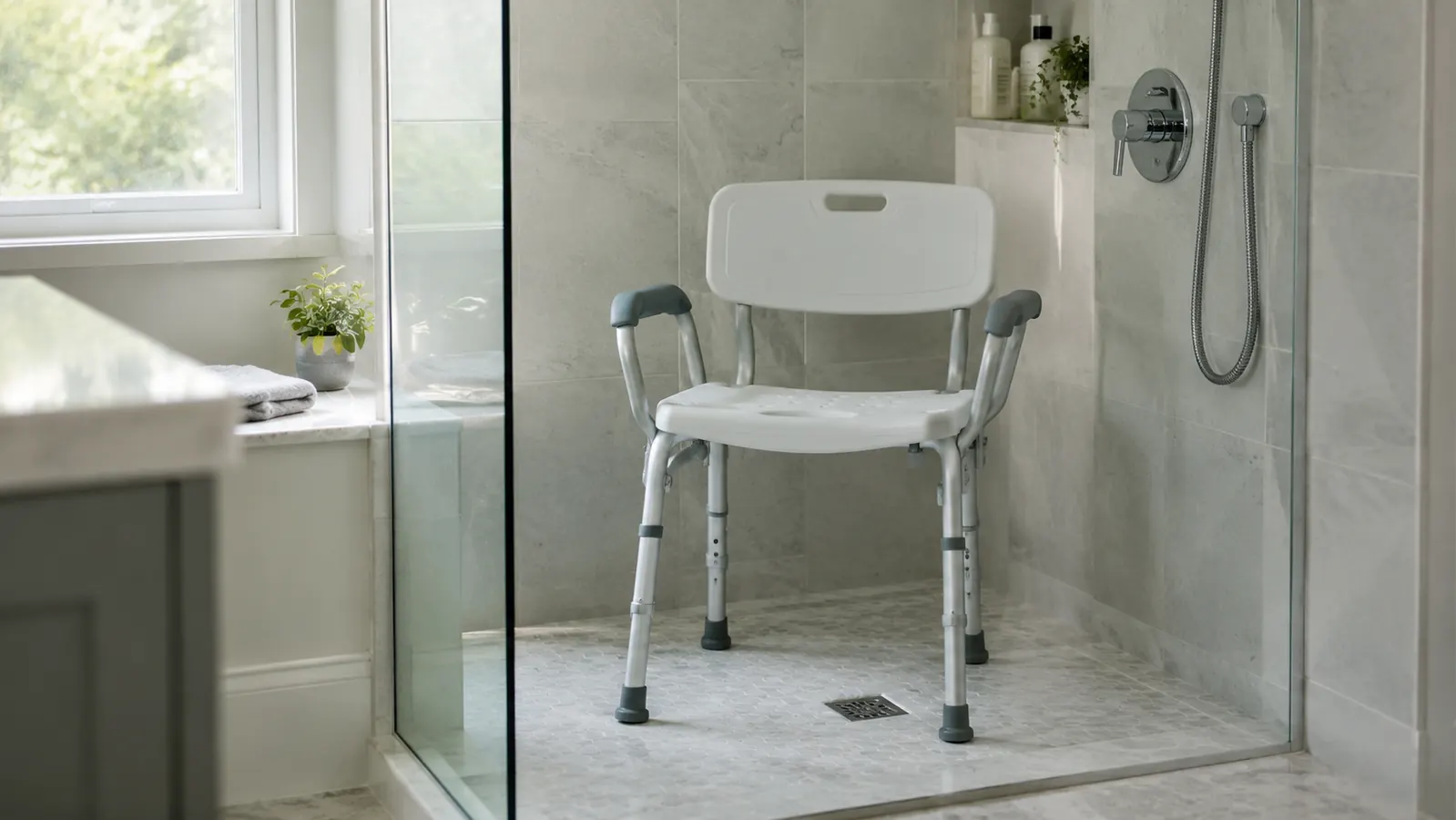
When the physical therapist told Gene he could not stand on one leg long enough to shower safely, I nodded along like I understood. Then I got home, looked at our tub-shower combo, and realized I had no idea what to do about it. We are both in our 70s. Gene is 76 with a knee replacement from two years ago. I am 71 with arthritis in both knees and one hip. We did not want to remodel the bathroom. We did not want a nurse. We just wanted Gene to wash his hair without me hovering in the doorway ready to catch him.
So we bought the Medline shower chair, the heavy duty one with padded armrests and a back. This is the honest version of that review. Not the product page version. The version that includes the box in the hallway for a week, the adjustment knob that fought back, and the afternoon I sat in it fully clothed just to see if I could get out again. I have no connection to Medline. I paid for this chair with our own money, and I am writing this because the decision was harder than it should have been.
The Quick Verdict
A sturdy, comfortable shower chair that does exactly what it promises, once you get past assembly and the learning curve of getting in and out. Worth it for anyone with balance issues, a recent surgery, or a bathroom that was not built for aging.
Amazon Check Today's Price →The chair that finally got Gene showering without me in the doorway
After two years of sponge baths and worry, this is the Medline shower chair we landed on. It is not glamorous. It is sturdy, adjustable, and it works.
Amazon Check Today's Price on Amazon →How I Have Actually Used It
I want to be clear about something. I am not a physical therapist and I am not giving medical advice. If you are choosing a shower chair after a fall or surgery, check with your doctor or physical therapist first. What I can give you is what happened in our house, with our bodies, over the months we have owned this chair.
Gene uses it every single day. I use it on the days my hip decides to remind me it exists. The chair lives in the tub-shower combo bathroom, which is the one we use most. We have a walk-in shower in the other bathroom, but the tub one is closer to the bedroom, and after a knee replacement, every step counts. On the mornings when my hip is stiff, I sit down to wash my lower legs instead of balancing on one foot. It takes me an extra few minutes, but I have not grabbed the shower curtain to steady myself in months.
The first week, Gene would not use it. He said it made him feel old. I said the floor made him feel broken. He used it the next morning. That is the honest truth about this chair. It is not a decoration. It is a tool, and like any tool, it only helps if you use it.
What Nobody Tells You About the Box
The box is heavy. Not unmanageable, but heavier than I expected. It arrived at the front door and sat in the hallway for a week because Gene could not lift it and I could not drag it without hurting my back. Eventually our neighbor across the street carried it in. If you live alone, or if you are the one recovering, plan for this. Have someone there when it arrives, or ask the delivery person to bring it inside.
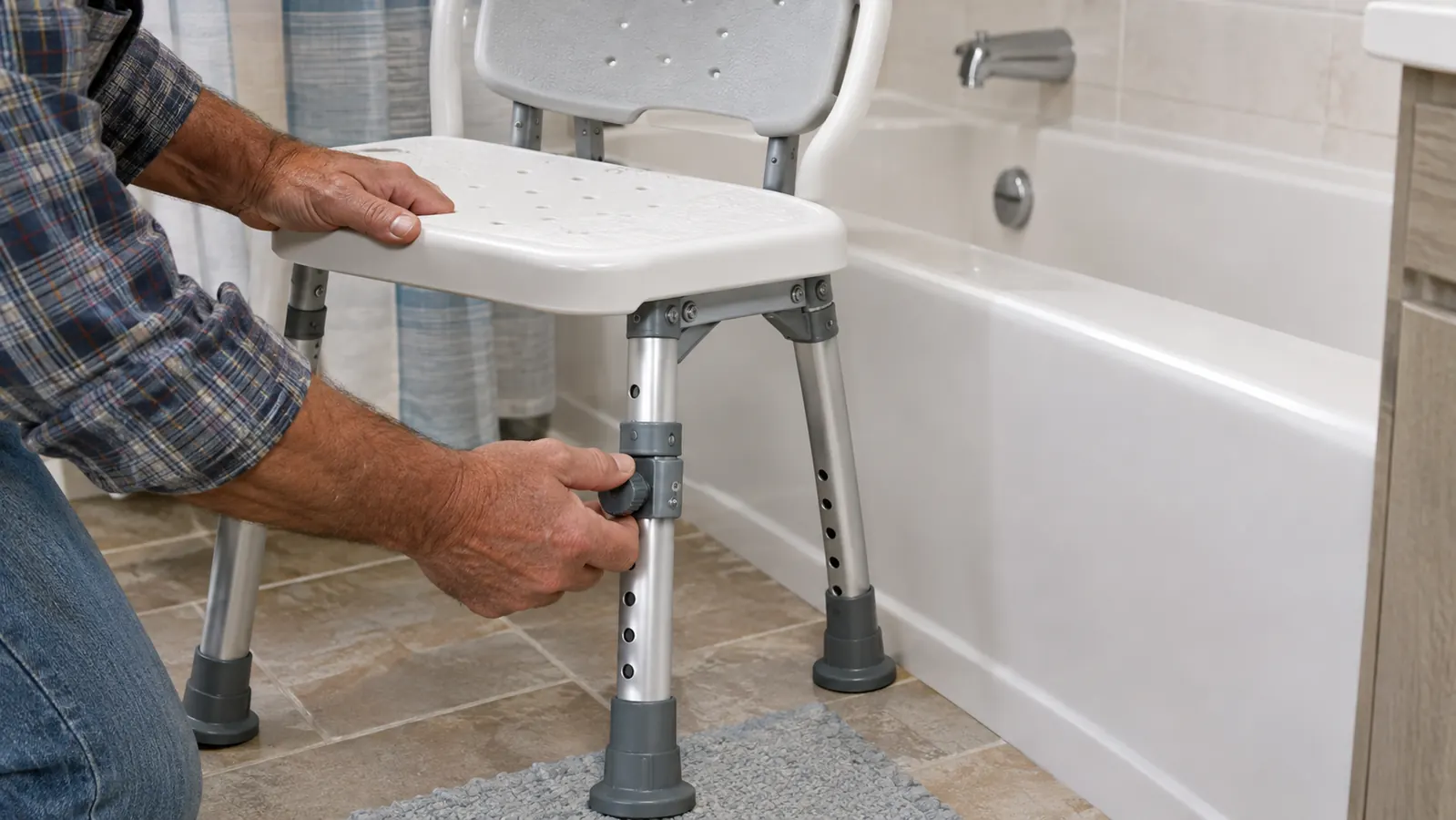
Assembly took about 30 minutes. The tools are included, which I appreciated. The instructions are mostly pictures, which I also appreciated. The hardest part is not the assembly itself. It is the adjustment knob on the back legs. It is stiff when it is new. Gene's hands are not as strong as they used to be, and he could not turn it. I could, but barely. After a few weeks it loosened up, but if you have arthritis in your hands, you may need help with this step. The tools are in a plastic bag taped to the top of the frame, which I almost threw away with the packing material. The legs slide into the frame, and the armrests clip in with a satisfying click. If I can assemble it at 71 with arthritis in my hands, most people can.
The knob that adjusts the height was so stiff at first that I had to use both hands and a lot of bad words. It loosened up after a few weeks, but nobody warns you about that.
The Height Adjustment Is the Whole Game
This is the thing I wish someone had explained to me before we bought it. The chair has adjustable legs, and the height setting is not a one-time decision. It is a process. You set it too high, your feet dangle. You set it too low, and you cannot stand up without using your arms to push off the whole way.
The goal, according to our physical therapist, is to have your knees at a slight downward angle when you sit. Not a right angle. A slight tilt, so your hips are a little higher than your knees. That makes it easier to stand up. We spent three days adjusting and readjusting. I sat in it fully clothed, in the living room, with a towel under it, just to practice getting in and out. The padded armrests helped a lot. They give you something solid to push against, and they are wide enough that they do not dig into your arms. The first time I set it, I set it too high because I was guessing. Gene sat down, his feet barely touched the floor, and he looked like a child in a grown-up chair. We lowered it two notches. Then we lowered it one more after he tried standing up and felt his knee complain. The final setting has his knees about two inches lower than his hips. That small change is the difference between a chair he can get out of and a chair that traps him.
One thing I will say about the 350 pound weight capacity. It is real. Gene is not a small man, and the chair does not wobble, flex, or creak when he sits down. That is the main reason we chose the Medline over a cheaper chair. The frame is aluminum, the seat is plastic, and the whole thing feels like it was built for a hospital, in the best way.
Getting In and Out Is a Skill
Here is what nobody tells you. The hard part is not sitting in the chair. The hard part is getting from standing to sitting, and from sitting to standing, without twisting your body in a way that hurts your knee or your hip.
The physical therapist showed us the safe way. You stand with your back to the chair, reach back with one hand to find the armrest, then the other hand, then lower yourself down slowly. To get up, you slide forward to the edge of the seat, plant your feet, and push up with both arms. It sounds simple. It is not, at first. Gene fell back into the chair harder than he meant to on day two, and the chair took it without a sound. That is when I stopped worrying about the chair and started worrying about teaching him the technique. The first time I tried it myself, I forgot the sliding forward part and tried to stand straight up from the back of the seat. My knees did not like that. The second time I scooted forward, planted my feet, and pushed. It was not graceful, but it worked. Now I do it without thinking, and I do it the same way every single time. Routine is what keeps you safe.
The slip resistant feet are not a gimmick. They grip the tub floor well, even with soap and water everywhere. I tested this by pushing the chair sideways with my hip while it was empty. It did not move. That test is not scientific, but it was enough for me.
What It Is Like to Shower Sitting Down
I will be honest. Showering sitting down feels strange at first. Water goes where it wants. You have to adjust your routine. Gene uses a handheld shower head, which we already had, and that made a big difference. With a fixed shower head, you would have to lean forward to get your back wet, which is exactly the kind of movement that hurts. The first time I used it, I reached for the soap on the little shelf we keep in the corner, and I could not quite reach it from a seated position. I had to stand up, grab it, and sit back down. We moved the soap to the edge of the tub, within arm's reach of the chair. It sounds like a small thing, but it is the difference between a shower that flows and one that is full of stops and starts.
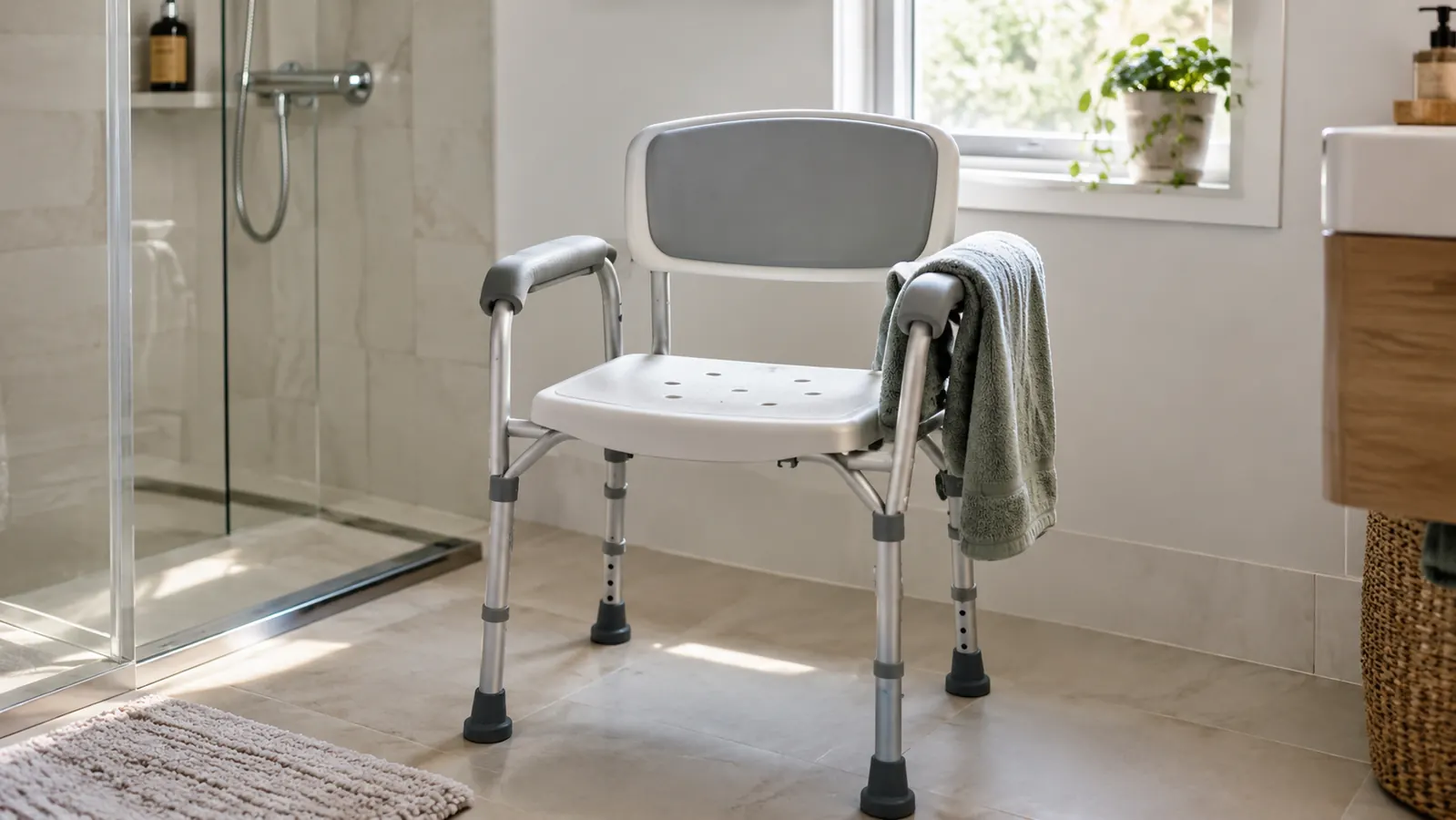
The seat has drainage holes, so water does not pool under you. That matters more than you think. A seat that holds water against your skin is cold and uncomfortable, and it can make you want to rush through the shower, which is when you slip. The padded armrests are covered in a material that dries quickly, and the backrest is tall enough that you can lean back without feeling like you are going to fall through.
Gene's routine now takes about 15 minutes. He sits, washes his upper body, stands up carefully, washes his lower body, and sits back down to rinse. It is not the shower he had five years ago. It is the shower he has now, and it is safe. That is worth more than any amount of pride.
The Downsides Nobody Mentions
I promised an honest review, so here are the downsides. The chair is not small. It takes up a significant portion of the tub, which means you have less room to move around. If you are used to turning around in the shower, you will have to get used to not doing that. I measured it one afternoon because I am a librarian and that is what I do. The chair sits inside the tub, and it leaves about a foot and a half of open tub in front of it. That is enough to stand and rinse, but there is no turning around.
The plastic seat is cold in the winter. We keep a small towel on the seat, which helps, but it is one more thing to wash. The chair also needs to be cleaned regularly. Soap scum builds up on the legs and under the seat, and if you do not wipe it down, it starts to look grimy. It is not hard to clean, but it is a chore you did not have before. I wipe the legs down with a sponge every Sunday while the bathroom is already wet from Gene's shower. It takes about five minutes.
The biggest downside is the one I keep coming back to. The chair is a reminder. Every time you look at it, you remember that your body does not work the way it used to. Gene said that out loud one morning, and I did not have an answer. The only thing I can say is that the alternative, falling in the shower, is worse. A fall is not a reminder. A fall is a hospital stay.
How It Compares to What We Tried Before
Before the Medline, we tried a bath stool. It was cheaper, and it was a mistake for us. The stool had no back and no armrests, and Gene could not use it without holding onto the wall, which meant he was not really safe. We also looked at a transfer bench, which sits half in and half out of the tub. That is a good option for some people, but it requires more upper body strength than Gene has right now, and it does not work well with a shower curtain.
The Medline chair is the middle ground. It is more than a stool, less than a remodel. It gives Gene a place to sit that is stable, and it gives me peace of mind. I still check on him when he is in the shower, but I do not stand in the doorway with my heart racing anymore.
What I Liked
- Sturdy aluminum frame with a real 350 pound weight capacity
- Padded armrests give you something solid to push against
- Height adjusts in small increments, so you can dial in the right angle
- Slip resistant feet grip the tub floor even with soap and water
- Seat has drainage holes, so water does not pool under you
- Tools included, assembly in about 30 minutes
Where It Falls Short
- Box is heavy and needs two people to move safely
- Height adjustment knobs are stiff when new
- Takes up a lot of room in a tub-shower combo
- Plastic seat is cold in winter
- Needs regular cleaning to keep soap scum off
- It is a visible reminder that you are getting older
Who This Is For
This chair is for anyone who has lost confidence in the shower. It is for the person who grips the wall with one hand while they wash with the other. It is for the spouse who stands outside the curtain, listening, ready to jump in. It is for the person coming home from a knee or hip replacement who needs something solid to sit on, not a flimsy stool.
It is also for the person who is not injured yet, but who knows their balance is not what it was. That was me. I bought the chair for Gene, and I use it myself on bad days. The chair does not make you old. Falling makes you old. The chair keeps you independent, and independence is worth every penny.
Who Should Skip It
If you have a walk-in shower with a built-in seat or a bench, you do not need this chair. If you have very limited upper body strength and cannot push yourself up from a seated position, a transfer bench or a chair with a lift mechanism might be a better fit. Talk to your physical therapist about what your body can do before you buy.
If you are looking for something small and discreet, this is not it. The chair is functional, and it looks like what it is: a piece of medical equipment. That does not bother me. It might bother you. The alternative, a bathroom remodel with a roll-in shower, costs thousands of dollars and takes weeks. The Medline cost a fraction of that and was in our bathroom the same week.
Stop hovering in the doorway. Get the chair.
We waited too long to buy this. If you are reading this because someone you love is unsteady in the shower, do not wait for a fall. This is the chair we trust.
Amazon Check Today's Price on Amazon →