

Mornings were the hardest part of my day. At 71, with mild arthritis in both knees and one hip, I could manage an afternoon walk around the neighborhood or my 20 minutes of chair yoga. What I could not manage was the first move of the day: rolling out of bed. I would lie there, brace one hand on the mattress, and heave myself upright. By the time I was standing, my shoulders ached, my balance felt shaky, and the day had already gotten the better of me.
Gene, my husband, had the same trouble after his knee replacement two years ago. We tried a firmer mattress, a step stool, even a folded blanket under the sheet. Nothing gave me a solid thing to hold onto. Then we added a Lunderg Bed Assist Rail to my side of the bed, and the hardest ten seconds of my morning became the easiest. This guide is how I use it, step by step, so you can get out of bed with stiff joints without grabbing the nightstand or calling for help. I am not a doctor, so please check with yours before changing how you move after a fall or surgery.
A handle that turns 'heave' into 'stand'
The Lunderg Bed Assist Rail slides between the mattress and box spring and gives you a firm grip on the side you get out of bed. See how it fits and check today's price on Amazon.
Amazon Check Today's Price on Amazon →Why a Bed Rail Made the Difference for Me
The problem was never the mattress. It was that I had nothing to hold onto. A mattress gives way when you push on it, and a nightstand is too far away and too easy to knock. A rail gives you a fixed point that does not move, which is exactly what your body needs when your knees are stiff and your balance is still waking up.
The Lunderg rail sits between the mattress and the box spring, so it takes up no floor space and does not change how the bed looks. The handle is there when you need it and out of the way when you do not. That simplicity is why I reached for it every single morning instead of leaving it in a closet.
I am not the only one who noticed. Gene watched me for a week and then asked me to order a second rail for his side. He is not someone who asks for help easily, and that told me more than any product description could. We are both a little stubborn about asking for help, so having a rail that simply does its job without being asked felt like a small kind of freedom.
Step 1: Put the rail where you actually get out
The rail only helps if it is on the right side of the bed. I sleep on the right side because that is closest to the bathroom, so that is where mine lives. Slide the flat plate between the mattress and the box spring, with the handle pointing up and slightly toward the center of the bed. The weight of the mattress holds it in place, and the clamp keeps it from shifting.
Before you trust it, push down on the handle a few times while you are still sitting up. I did this the first morning before I needed it. The rail should not move, wobble, or slide. If it does, lift the mattress, seat the plate deeper, and tighten the clamp again. Ten seconds of checking now saves you from grabbing a loose handle later.
If you share a bed, think about which side each person gets out of. Gene gets out on his side, so we eventually put a second rail there too. It took about five minutes to install the first one, and most of that was me being particular about where the handle sat. The second install went even faster, because we already knew exactly how the plate sat and how tight the clamp needed to be.
Step 2: Sit up in stages, not in one motion
The mistake I used to make was going from lying flat to sitting up in a single heave. That puts all the strain on your lower back and shoulders at the exact moment your joints are stiffest. Instead, bend your knees, roll onto your side facing the rail, and let the hand closest to the rail reach for the handle.
Push up with that arm while your other hand stays flat on the mattress. Keep your feet on the bed until you are fully upright. This is not a race. I count to three at each stage, and those extra seconds are what keep my hip from complaining for the rest of the morning.
The rail gives you something to pull against, but it is not a rope you yank. Move slowly, keep your shoulders relaxed, and let your arm guide you rather than haul you. If you have had surgery recently, ask your physical therapist to show you a safe way to get up before you practice on your own.
Step 3: Stand with both hands doing different jobs
Once you are sitting with your legs over the edge, plant both feet flat on the floor. Grip the rail with one hand and place the other hand on the mattress beside your hip. Rock forward slightly so your weight moves to the front of the bed, then push down through your legs and stand.
The rail is there to steady you, not to lift you. Pulling your whole body up with one arm is a good way to strain a shoulder. Let your legs do the work and use the handle to keep your balance. If you need to, scoot to the very edge of the bed first so your feet are squarely under you before you stand.
This was the step that took me the longest to learn, because I was used to lunging for the nightstand. The nightstand moved, which made everything worse. The rail does not move. Once I stopped reaching for furniture, my mornings changed, and so did the way my shoulders felt. That is the quiet benefit nobody mentions: a rail changes your habits, and changed habits are what keep you steady.
Step 4: Give your joints a moment before you walk
This is the step I almost skipped, and it made the biggest difference. When I first got the rail, I would stand up and walk straight to the bathroom. My knees would ache for the rest of the morning. Now I stand still for a few seconds, hand still on the rail, and let my joints wake up.
I look at my feet, make sure I feel steady, and take one slow breath. If you have had a fall or surgery, check with your doctor or physical therapist before you change how you move in the morning. For me, those extra five seconds are the difference between a stiff start and a smooth one.
Gene does the same on his side. He had his knee replaced two years ago, and the first few steps after standing are the ones that worry him. A few seconds with his hand on the rail gives him confidence before he walks to the bathroom. It sounds small, but it is the part of the routine we both rely on.
Step 5: Use the same rail to get back into bed at night
The rail is not just for mornings. At night I sit on the edge of the bed, grip the handle, and lean toward the middle of the mattress before I lift my legs up. That small lean keeps me from flopping backward. It also gives me something to hold while I get comfortable, instead of grabbing at the sheets.
If you share a bed, it is worth considering a rail on each side. They do not take up floor space, and they do not change how the bed looks. They just give each person a solid handle where they need it. We ordered a second one for Gene's side after the first week, and neither of us would go back.
One thing I will mention honestly: the rail is not a grab bar for the bathroom or a walking aid. It does one job, helping you get in and out of bed, and it does that job well. If you need help with other parts of your day, talk to your doctor about what equipment fits your situation.

What to Look for in a Bed Rail
Before we settled on the Lunderg, I looked at a handful of options. The things that mattered most to me were a handle that sits at a useful height, a base that stays put, and a setup that does not require tools or a call to someone else. If you are shopping, those three things will matter to you too.
The handle needs to be easy to reach from a lying position, not so high that you strain and not so low that you have to bend. The base needs to grip the bed frame without slipping. And the whole thing needs to go in without a toolbox, because the person installing it may be the same person who needs it.
I will also say this: read the part about what bed frames it fits. Our bed is a standard frame with a box spring, and the Lunderg went in without trouble. If your bed is adjustable or has a platform base, measure and check before you order, because not every rail fits every frame.
One thing I would not trade for any feature: the rail is quiet and low profile. It does not announce itself, and it does not get in the way of making the bed. That mattered more than I expected.
What Else Helps
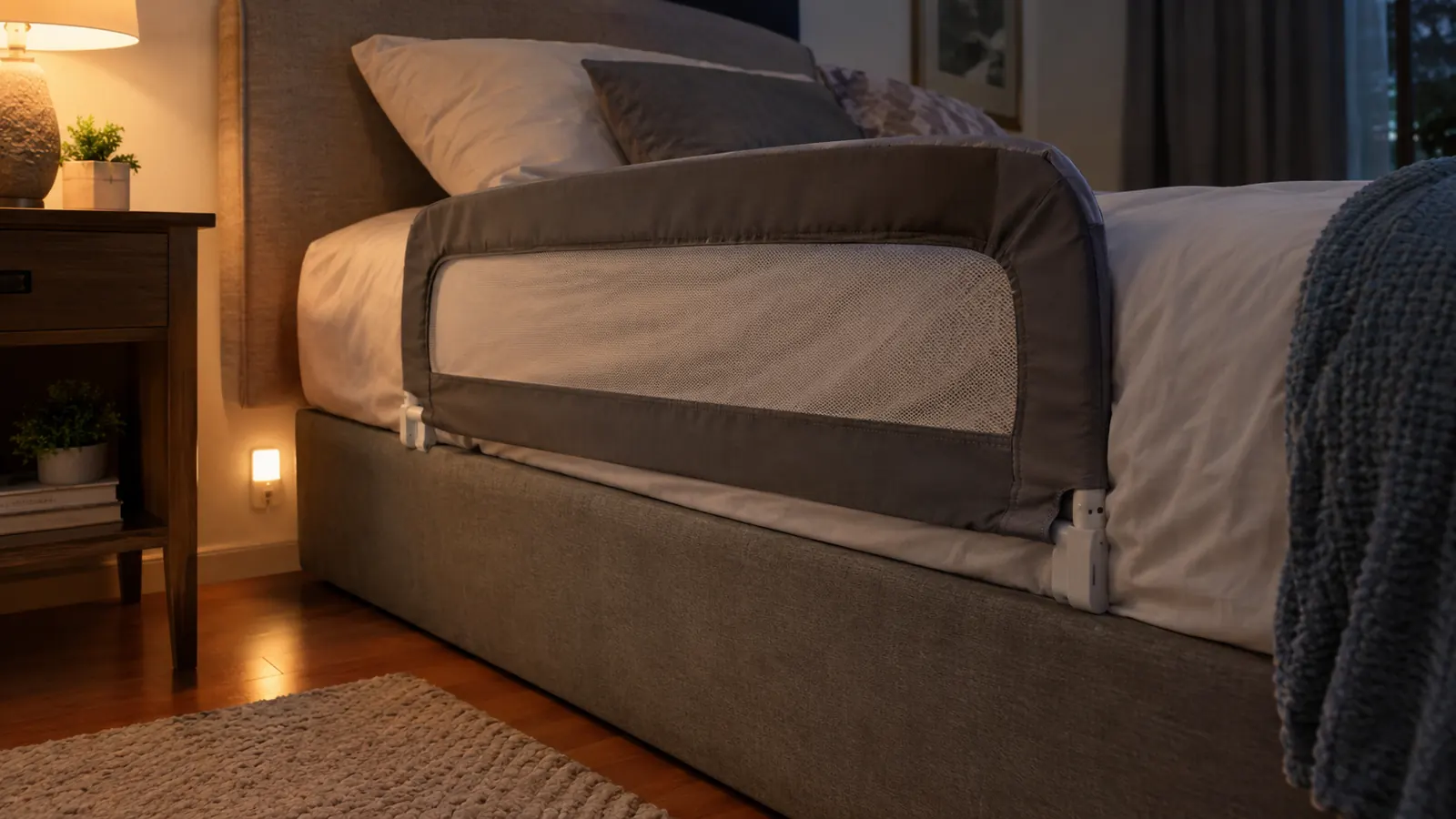
Getting out of bed is easier when the path is ready for you. I keep a small nightlight near the bathroom, my slippers have grippy soles, and I clear the rug beside the bed so nothing is in the way when I stand. The rail handles the hardest part, but the rest of the morning goes better when the room is set up for safe movement.
I also do my 20 minutes of chair yoga most mornings, and I notice that on the days I skip it, my knees are stiffer at the bedside. That is not medical advice, it is just what I have observed in my own house. If your joints are stiff, talk to your doctor or physical therapist about what stretches are safe for you.
One more thing that helped us: we moved the phone chargers off the nightstands. With the rail in place, the top of the nightstand is the last thing I touch in the morning and the first thing I reach for at night. Keeping it clear means I can always find it without looking. It sounds like a small thing, but when your eyes are still adjusting in the dark, a clear surface is a relief.
I stopped bracing myself on the nightstand, and within a week the morning ache in my shoulders was gone. That is the honest proof from my side of the bed.
The Honest Bottom Line
Nobody wants to start the day by wrestling their own bed. A bed rail will not cure stiff joints, and I would never pretend it does. What it did for me was remove the one move that hurt the most, so the rest of my morning had a fair chance. The bed is not the enemy, but the way I used to leave it was. If you are deciding whether a rail is worth trying, that is the honest answer: it made the hardest ten seconds of my day feel ordinary, and it can do the same for you.
If you are not sure where to start, ask your doctor or physical therapist about whether a bed rail is right for you. They can also show you the safest way to get in and out of bed after a fall or surgery. That is the advice I would give a friend sitting at my kitchen table, and it is the advice I am giving you.
Start tomorrow with a steadier first step
The Lunderg Bed Assist Rail is easy to install, holds firmly between mattress and box spring, and gives you something solid to grip on both sides of the bed. Check today's price on Amazon.
Amazon Check Today's Price on Amazon →