
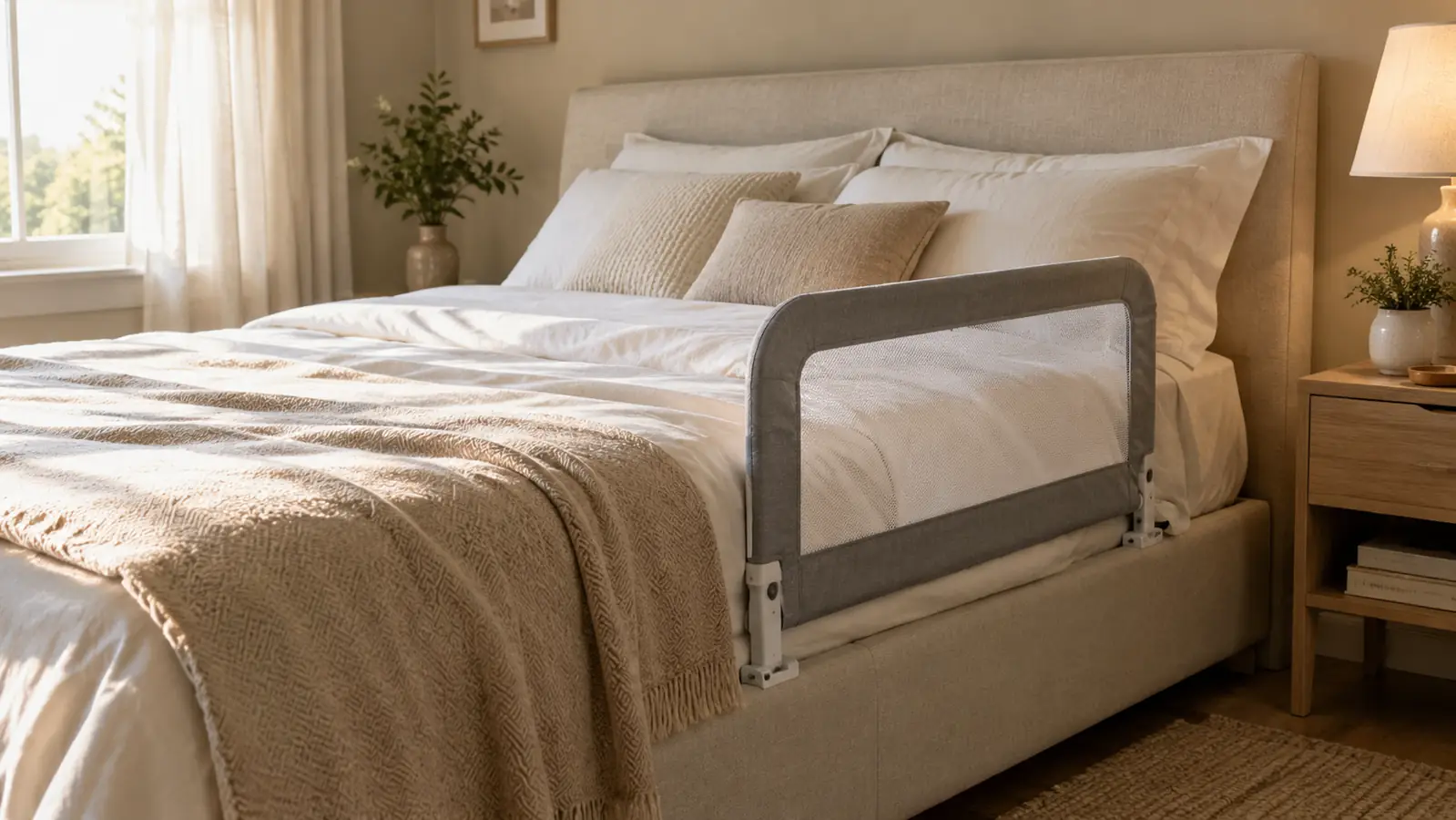
The thing nobody tells you about getting older is that getting out of bed becomes a negotiation. Not a dramatic one, not the kind you see in movies. Just a small pause at the edge of the mattress while you decide whether your knees are going to cooperate. For my husband Gene, 76, that pause started after his knee replacement two years ago. For me, 71, it's the arthritis in both knees and one hip that makes the first steps of the day slow and careful. We ordered the Lunderg Bed Assist Rail for Gene. Six weeks later, I'm the one who reaches for it every single morning.
Let me tell you what this thing is, because the name doesn't say enough. It's a rail that slides under your mattress and clamps to the bed frame, with a non-slip grab bar on top at about the height you need when you're sitting on the edge of the bed. You grip it, you push, and you're up. No tools, no holes in the wall, no permanent changes. We've had ours for six weeks, through one bad knee episode, a lot of 2am bathroom trips, and one very honest argument about whose turn it was to change the sheets. Here's what I'd tell a friend before she ordered one, including the parts I wish someone had told us.
The Quick Verdict
A steady, no-tools grab bar that made our nights safer once we got the fit right. It is not a lift and it is not a hospital rail. Read the cons before you order, then read them again after the first week.
Amazon Check Today's Price →The rail we reach for every single morning
Six weeks in, here's the honest rundown: what held up, what loosened, and what I'd check before you install yours.
Amazon Check Today's Price on Amazon →How I've Used It
Gene's knee replacement was two years ago, but he still has bad mornings, especially when the weather turns damp. I have mild arthritis in both knees and one hip, and my chair yoga helps, but it doesn't make me spring out of bed. Our bedroom is the back one, with carpet and a standard queen bed. Neither of us needed a hospital bed. Both of us needed something to hold onto that wasn't the nightstand, the lampshade, or each other.
Installation took about ten minutes the first time, and I did it myself with Gene supervising. You slide the flat base under the mattress, pull the rail up snug against the side of the bed, and tighten the clamp by hand. No tools in the box, which was the first thing that made me trust it. The second thing was the grip. The grab bar has a non-slip texture that feels secure even when your hands are cold and you're half awake at 2am.
We had to redo the installation once, and I'm glad we did. The clamp felt tight, but the rail wobbled when Gene leaned on it, so we loosened it, slid the base a little deeper under the mattress, and tightened it again. That second time, it didn't move. The instructions say to re-tighten after a few nights. That is not a suggestion. It's the difference between a rail you trust and a rail you flinch at.

What the Rail Actually Does (and Doesn't Do)
Here's the honest part. The Lunderg rail gives you leverage. You grip the bar, you push down, and your body rises with the motion. For someone with a replaced knee or stiff hips, that little bit of help is the difference between a smooth get-up and a wobbly one. It works because your weight presses the base down against the floor, which locks the rail in place. The more you lean on it, the firmer it holds. That's a clever design, and it's the reason we kept it.
What it doesn't do is lift you. If you need help rising from a seated position, or if you're recovering from surgery and can't put weight on one arm, this is not the tool for the job. That's a hospital bed or a proper lift chair, and you should ask your doctor or physical therapist about those before you buy anything. The rail is an assist, not a machine. I know that sounds obvious, but read the reviews and you'll see people expecting it to do more than a rail can.
It also only helps one side of the bed. Gene and I each have a side, and for the first week I kept reaching across the bed for the rail on his side, which is a great way to wake up with a sore shoulder. The fix is simple if you have room: we have a rail on each side now. If that's not an option, decide which side the person who gets up at night uses, and put it there. That's the side that matters.
The First Week: What Nobody Tells You
The product photos show a tidy bed and a person rising smoothly, like it's the most natural thing in the world. Nobody tells you about the first night, when your shin finds the base of the rail in the dark. Nobody tells you that the gap between the mattress and the rail can swallow a hand or a foot if the clamp is too loose. That's a real thing, and it's the main reason the fit matters more than anything else about this product.
Check the gap the way you'd check a child's car seat. Slide the rail so it sits close to the mattress, but not so close that it pushes the mattress up and creates a lump. If you can fit more than a finger between the mattress and the rail, tighten the clamp and push the base deeper. I check ours every Sunday now. It takes ten seconds, and it's the difference between a safe rail and a hazard. I'm not being dramatic. That gap is how a hand gets pinched.
The other thing nobody tells you is the sheets. A rail on the side of the bed means the fitted sheet has to go around the base, and the flat sheet has to tuck under it. It's a two-person job now. Gene holds the rail up while I work the sheet underneath, and then we both complain about it. It added about three minutes to our routine. And that grip texture I praised? It snags a pajama sleeve if you're not careful. You learn to grab the bar rather than drag your arm across it. These are small things. They're just real.
I read dozens of reviews before we ordered, and they split into two camps. Five stars from people who got the fit right on the first try. Three stars from people who gave up after the first wobble. Both groups are describing the same rail. The difference is whether they took the time to set the clamp properly. That's the honest summary of this product, and it's why I keep telling you to slow down during installation.
How It's Held Up Over Six Weeks
After six weeks of daily use, the rail is as steady as it was on day two. The clamp hasn't loosened since our re-installation, and the non-slip grip shows no wear. I was worried the texture would rub off or get slick the way some grips do, but it hasn't. It still feels the same at 2am as it does at 2pm, which is the highest praise I can give a piece of safety gear.
The rail has taken some real abuse. Gene leans on it hard on his bad mornings, and I use it as a brace when I'm doing my chair yoga next to the bed. It hasn't shifted, hasn't marked the carpet, and hasn't loosened. The one thing we do differently now is check the clamp weekly, because the instructions ask for it and because we learned our lesson in week one.
The surprising part is how much I use it during the day. I grab it when I'm making the bed, when I'm reaching for something on the nightstand, and when I'm getting up from the edge of the mattress after reading. It's become part of the furniture, which is exactly what a good mobility aid should be. You stop noticing it until you need it, and then it's right there. That's the whole point.
If you're reading this because you or your spouse just had a fall or a surgery, talk to your doctor or physical therapist first. They can tell you whether a rail like this is enough or whether you need something more. That's the advice I'd give my own sister, and it's the advice I'm giving you.

The Gripes That Almost Made Us Send It Back
I want to be straight with you about the things that annoyed us, because a review that only praises is a review you can't trust. The first gripe was the wobble on day one, which we fixed by re-installing. The second was the shin incident, which we fixed by learning where the base sits. The third is the one I can't fix: the rail is always there. It's in the way when I vacuum, it's in the way when I change the sheets, and it's the first thing I see when I walk into the bedroom.
That last one sounds silly, but it matters. A rail on the bed is a daily reminder that we're not as young as we were. It took me a while to get used to seeing it. Gene got over it faster than I did. He said it's just a tool, like his cane or his reading glasses. He's right, and I'm telling you this because if you're buying for a proud parent or a stubborn spouse, the emotional adjustment is real. Give it a week.
Alternatives We Considered
Before we ordered the Lunderg, we tried two other approaches. The first was a cane hooked over the bed frame. It slid, it fell, and it nearly took a lamp with it. The second was a floor-standing rail that sits next to the bed. It was steady, but it took up floor space, and in our bedroom there isn't much to spare. We also looked at hospital-style rails, the kind that clip to the side of a hospital bed. Those are built for a different bed entirely, and our queen frame isn't compatible.
The Lunderg sits somewhere in between. It's steadier than a cane and takes up less floor space than a floor-standing rail. It doesn't require any permanent changes, which mattered to us because we're not ready to think of our bedroom as a hospital room. The tradeoff is that it only helps one side of the bed, and it needs a mattress with enough firmness to hold the base. Ours is medium-firm and it works. A very soft foam mattress might not hold it.
What I Liked
- Steady once installed. The more you lean on it, the firmer it locks.
- No tools needed. Installs in about ten minutes.
- Non-slip grab bar feels secure even at 2am.
- No permanent changes to the bed or the frame.
- Takes up no floor space in a small bedroom.
- Easy to re-tighten and adjust as the mattress settles.
Where It Falls Short
- The gap between mattress and rail needs a weekly check.
- Sheet changes are now a two-person job.
- The base can find your shin in the dark until you learn where it is.
- Only helps one side of the bed.
- Not a lift. It won't help you rise if you can't push with your arms.
- May not hold on a very soft memory foam mattress.
We bought it for Gene's replaced knee. Six weeks later, I use it more than he does.
Who This Is For
This rail is for someone who can stand up on their own but needs a steady point of contact to do it. That's a narrower description than you'd think, and it's the right one. If you pause at the edge of the mattress, if you brace yourself on the nightstand, if you wake up stiff and need one good push to get moving, this is for you. It's especially for the person who gets up at night, because that 2am trip is when balance is worst and falls happen.
It's for couples, too, in a way the reviews don't talk about. Gene and I both use it, and it's quietly changed who helps whom. I don't have to wake him when I get up at night, because I have the rail. He doesn't have to call for me on his bad mornings, because he has the rail. There's a dignity in that which is hard to describe to anyone who hasn't needed it.
One more thing. The rail helped us more than we expected because we installed it before we needed it, not after. Gene's knee was already replaced, and my arthritis was already there, but neither of us had fallen. We bought the rail to prevent a fall, not to recover from one. If you're waiting until after a fall to make the bedroom safer, you're waiting too long. That's the advice I wish someone had given us a year earlier.
Who Should Skip It
Skip this rail if you need more than leverage. If you've had surgery and can't push with one arm, if you need help rising from a seated position, or if your doctor has told you to avoid putting weight on your hands, this is not the tool. Ask about a hospital bed, a lift chair, or a ceiling-mounted lift. The rail is an assist, not a solution for every mobility problem, and pretending otherwise is how people get hurt.
Also skip it if your mattress is very soft. The base needs firmness to hold the rail. On a plush memory foam mattress, the rail can tilt or slide, and that's dangerous. And if you're buying it for someone who forgets it's there, plan to watch them closely for the first week. It's a tool, not a babysitter. Check with your doctor or physical therapist before you choose any aid after a fall or surgery. That's not a disclaimer, it's just sense.
If one of you is the first one out of bed at night, this is the rail we'd buy again
Check your mattress firmness, measure the side of your bed, and read the fit notes above. Then decide with your eyes open.
Amazon Check Today's Price on Amazon →