When the physical therapist first suggested a rollator for my husband Gene, I nodded along and then went home and cried in the laundry room. That part is not in the brochure. Two years after his knee replacement, Gene still used a cane, and a walker with a seat felt like a surrender. What nobody tells you is that the surrender is the point. You stop fighting the walk and start taking the walk.
We have had the Drive Medical rollator with 7.5 inch wheels for six months now. Gene uses it every day, and I use it on my afternoon walks when my hip acts up. This is the honest version, the one I would give a neighbor over the fence. I will tell you what works, what wobbles, and what I wish someone had told us before we ordered.
The Quick Verdict
A sturdy, honest tool that earns its place in the hall closet. It will not fix a knee, but it will get you to the garden and back without fear.
Amazon Check Today's Price →The rollator we reach for every single day
After six months of daily use, the Drive Medical rollator is still the first thing Gene grabs on the way to the kitchen. If you are comparing models for the first time, this is the one to measure everything else against.
Amazon Check Today's Price on Amazon →How I've Used It
Gene is 76 and had his right knee replaced two years ago. He is not the type to complain, which means he suffered in silence longer than he should have. The cane helped on flat ground, but it did nothing for balance when he was carrying a cup of coffee, and it did not give him anywhere to sit when we walked the neighborhood loop.
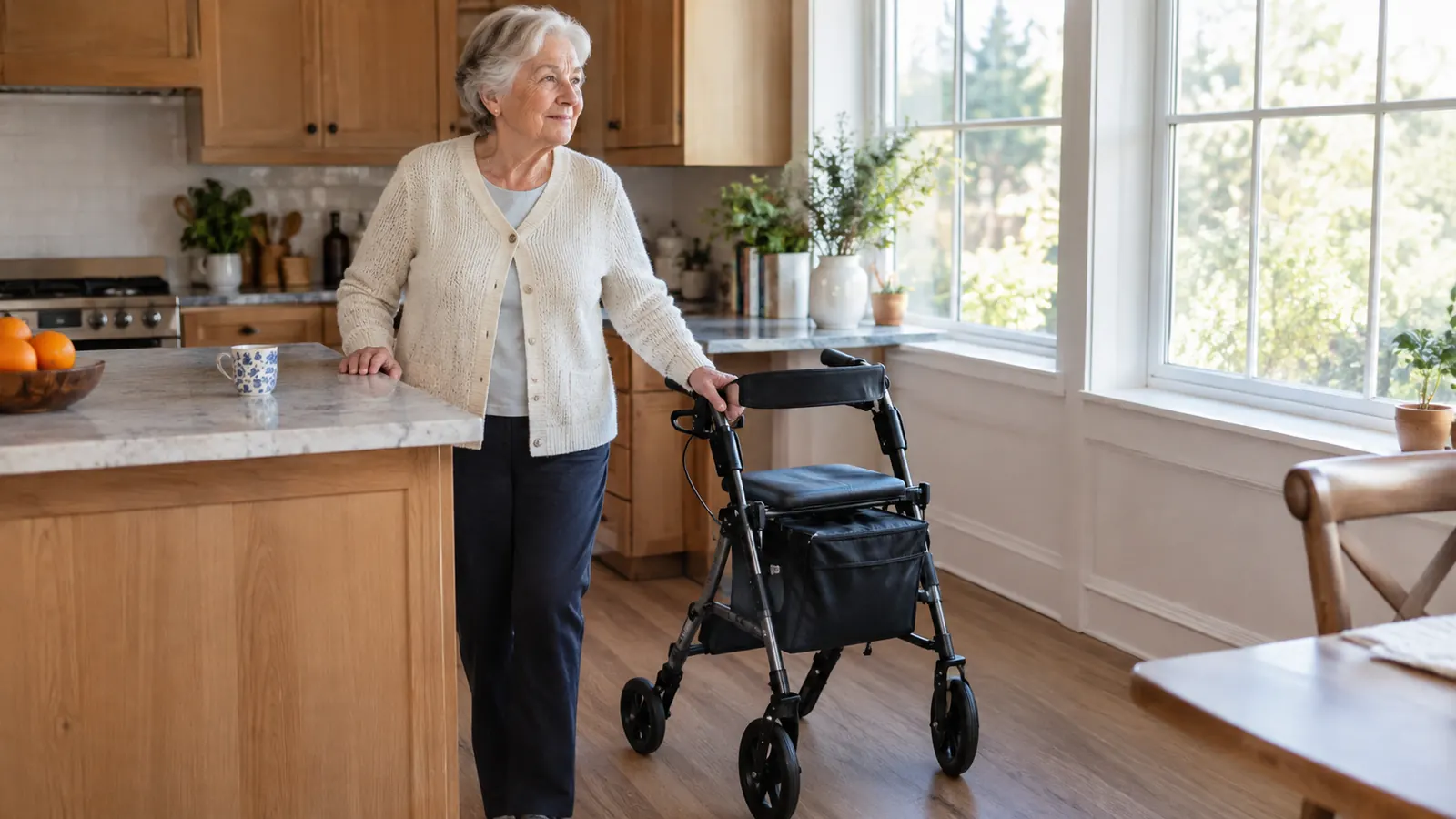
The Drive Medical rollator changed the shape of his day. He wheels it from the bedroom to the kitchen every morning, parks it at the counter while he makes toast, and uses the seat when he needs to rest. The 7.5 inch wheels roll smoothly over the laminate in the kitchen and the sidewalk out front, and the brakes lock before he sits down. That locking step matters. It keeps the rollator from rolling out from under him, and it gives me peace of mind I did not have with the cane.
I use it too, more than I expected. My arthritis is mild, mostly a morning stiffness in both knees and one hip, and there are afternoons when a mile feels like two. With the rollator, I can walk to the end of the street and sit down for a minute before I turn around. That minute is the whole difference between going out and staying home.
The First Week: Assembly and Adjustments
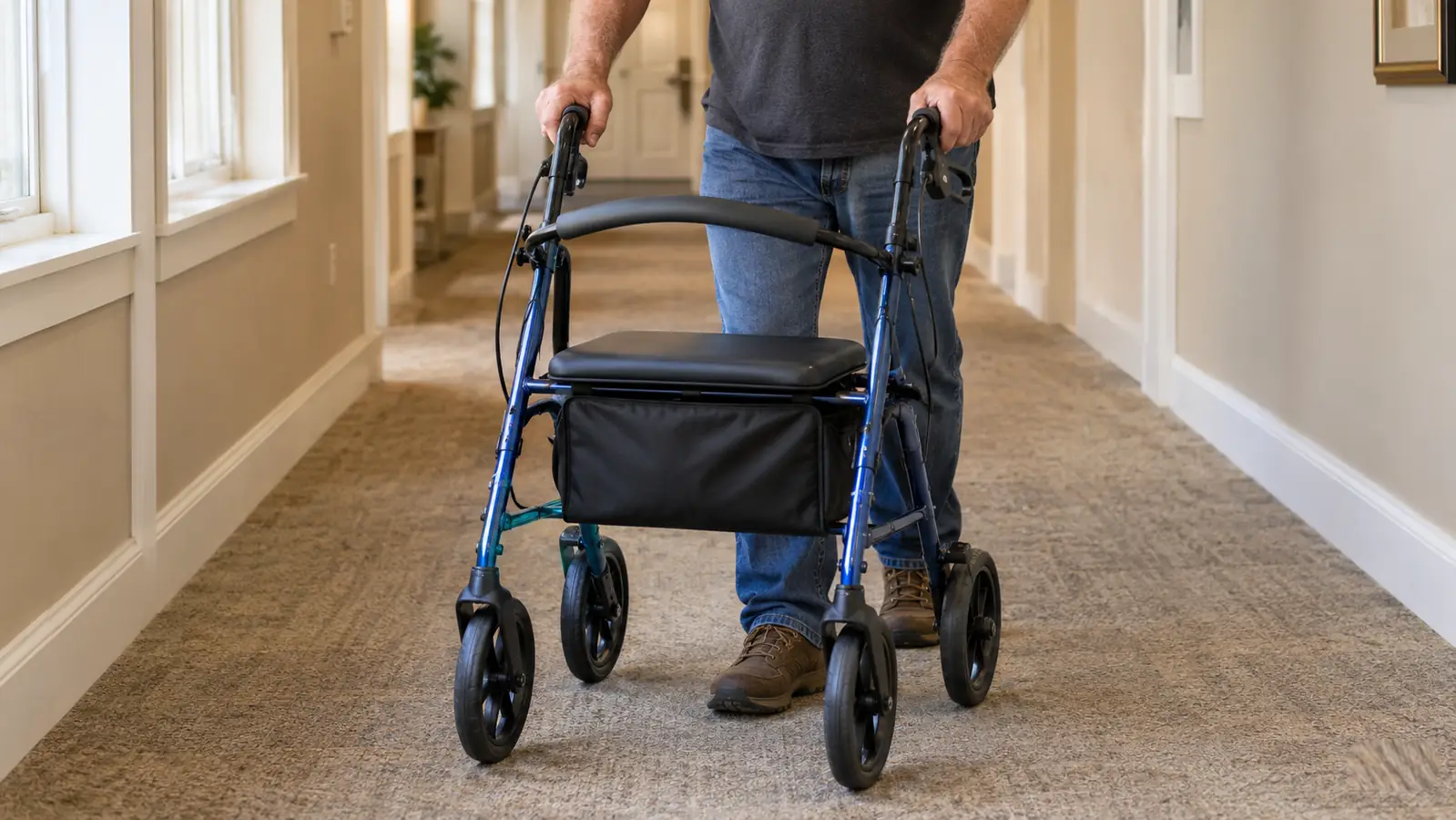
The Drive Medical rollator arrives mostly assembled. The handles need to be set to the right height, and that took us about fifteen minutes in the living room with a screwdriver and the instruction sheet. Gene is 5 foot 9, and the push-button height adjustment has eight positions, so we found his height on the first try. The whole process was easier than assembling a new grill, and there were no missing parts.
The first walk was wobbly in a way that had nothing to do with the rollator. Gene held the handles too tight, took steps that were too short, and kept looking down at the wheels. By the third day he had relaxed, and by the end of the first week he was wheeling it around the kitchen without thinking. Give yourself a few days. The rollator is not the thing that needs to learn.
One adjustment we made right away: we moved the storage pouch from the front to the backrest. The pouch in the front made Gene's knees bump it with every step. On the backrest, it does not get in the way, and the seat still folds. That is the kind of detail you only learn by living with it.
What Nobody Tells You Before You Buy
First, the brakes. The Drive Medical rollator has loop locks that you squeeze to slow down and push down to lock. They work exactly as they should, and I mean that as high praise. What nobody tells you is that they need a firm grip. My hands are not what they were at 50, and for the first two weeks I had to remind myself to squeeze evenly, or the rollator pulled to one side. If you have arthritis in your hands, or your grip strength is weak, test the brakes before you commit.
Second, the seat is not a cushion. It is a firm plastic bench that is wonderful for resting and terrible for sitting on longer than a few minutes. Gene uses it the way it is meant to be used, as a place to catch his breath, not a chair to watch television from. If you want something to sit on for an afternoon at the park, a transport chair is a better fit.
Third, it is heavier than it looks. I can lift the Drive Medical rollator into the trunk of our sedan, but I would not want to do it every day with a bad shoulder. Gene has no trouble, and the weight is part of why it feels so solid under his hands. There is a tradeoff between weight and sturdiness, and this one comes down firmly on the side of sturdy. If you live alone and need something you can lift one-handed, keep looking.
Fourth, the storage pouch is smaller than it appears in the photos. It holds a phone, a set of keys, and a small water bottle, and that is about it. We keep a second pouch hooked over the backrest for the mail and Gene's reading glasses. Not a dealbreaker, but know before you buy, because the basket underneath is small too.
Fifth, the rollator will make you visible in a way you are not used to. Strangers hold doors, children stare, and well-meaning relatives ask if you are okay. I will not pretend that is easy. But I will tell you what Gene told me: he would rather have people hold the door than stay home. That shift in thinking took him two weeks and one very good afternoon at the farmers market.
What It Does Well
The wheels are the star. The 7.5 inch front wheels are large enough to handle the crack where our driveway meets the sidewalk, the bump at the pharmacy entrance, and the gravel at the edge of the park path. A rollator with smaller wheels catches on every pebble and sends a jolt up your arms. This one just rolls.
The brakes deserve their own paragraph. Gene had a moment in the first week where he needed to stop suddenly on a slight downhill, and the loop locks brought him to a controlled stop without lurching. That is the test that matters. A rollator is only as safe as its brakes, and these are the most reassuring we tried.
The seat and backrest are positioned well for Gene. He can sit without stooping, and the height of the handles adjusts easily with a push-button mechanism. We set it once and have not touched it since. The frame feels solid, no rattling after six months of daily use, and the whole thing wipes clean with a damp cloth. When company comes, it folds up and stands in the hall closet like it belongs there.
What I Liked
- 7.5 inch wheels roll smoothly on sidewalks, driveways, and store floors
- Loop-lock brakes stop firmly and lock for sitting
- Folds flat in seconds and fits in a sedan trunk
- Solid frame with no wobble after six months of daily use
- Handles adjust easily for different heights
Where It Falls Short
- Firm plastic seat is fine for resting, not for lounging
- Brakes require a fairly strong grip
- Heavier than it looks when lifting into a trunk
- Storage pouch is smaller than the photos suggest
After six months, Gene's knee is no better and no worse. But he walks a mile every afternoon instead of watching the clock from the porch, and I think that counts as a win.
Around Our House, It Earns Its Keep
Our house is a one-story ranch, which sounds flat until you live in it. There are three steps up to the front porch, a lip at the back door, and carpet in the bedrooms that grabs at small wheels. The Drive Medical rollator handles the carpet without complaint because of the larger wheels, and the brakes let Gene park it at the top of the porch steps while he finds his keys.
The bathroom is the room we worried about most. We have a tub-shower combo in the main bath and a walk-in shower in the second. The rollator does not fit through the narrow bathroom door, so it lives in the hallway while Gene uses the walk-in shower with a shower chair. That is not a criticism of the rollator, just a truth about our floor plan. Measure your doorways before you order, and measure them twice.
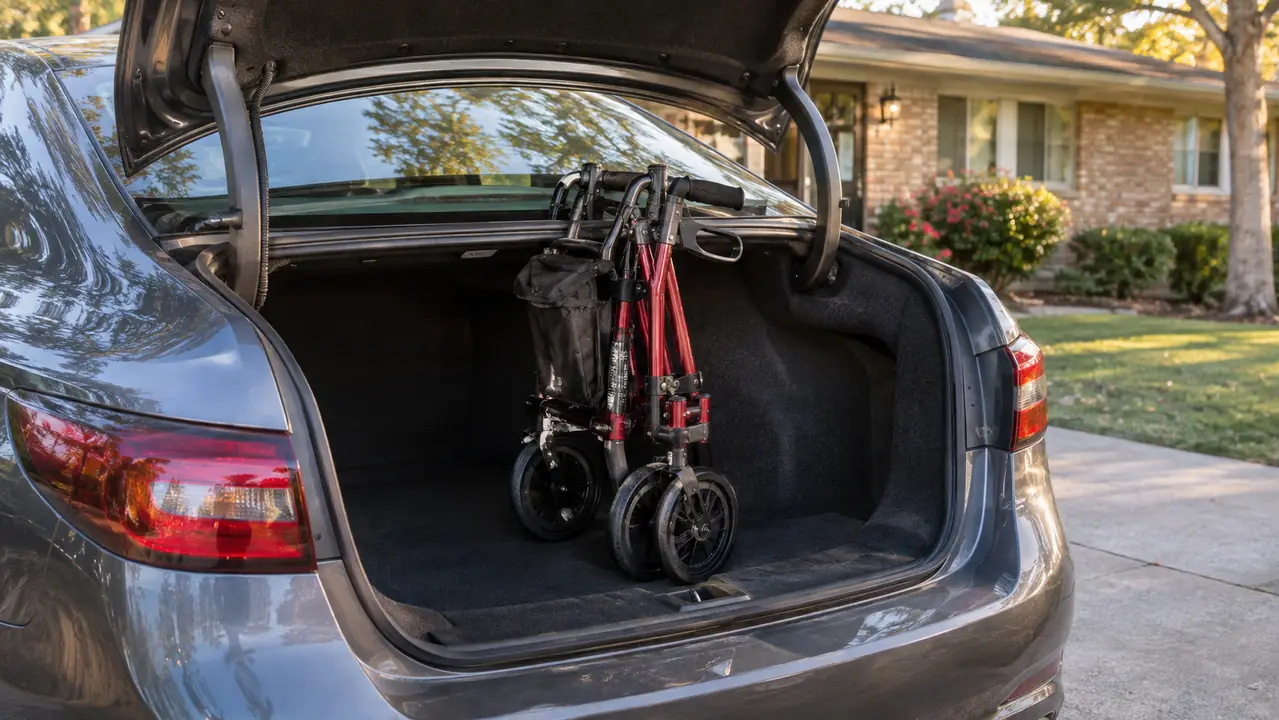
We fold it and put it in the trunk of our mid-size sedan when we go to the grocery store. The folding is a single strap, and it stands upright in the trunk with room left for a few bags. At the store, Gene pushes it like a shopping cart and parks it at the end of the aisle. The basket underneath is small, but it carries a loaf of bread and a carton of milk, which is more than a cane ever did.
How It Compares to What We Tried Before
Before the rollator, Gene tried a standard walker with tennis balls on the legs, the kind the hospital sent him home with. It was steady, but it had no seat, no wheels on the front that turned, and he had to lift it with every step. On a bad knee, lifting a walker is the last thing you want to do. The Drive Medical rollator glides instead of lifts, and that single difference is why it stayed out of the closet.
We also borrowed a rollator with 6 inch wheels from a friend for a weekend. The smaller wheels caught on the lip at our back door and made the whole frame shudder. That weekend convinced us that wheel size matters more than any other spec on the page. The 7.5 inch wheels on this one turn the lip into a non-event.
I am not going to tell you this is the only rollator worth buying. It is not the lightest, and it is not the least expensive, and I have not tested every model on the market. What I can tell you is that it is the one we chose after comparing, and six months later we have not regretted it.
Caring for It, and the Small Repairs
The maintenance has been simpler than I expected. The wheels pick up dust and the occasional leaf from the garden path, but a damp cloth takes care of it. The brakes have needed one tightening in six months, and the manual shows how in three clear pictures. Gene did it himself with a hex wrench that came in the box.
The fabric on the seat and backrest has held up well. No tears, no stretching, and the stain from Gene's coffee came out with soap and water. The frame has a few small scratches from the trunk of the car, but nothing that affects how it works. This is a tool, not a piece of furniture, and it looks like a tool that is used.
A Note on Safety
Two things our physical therapist told us that I want to pass along. First, lock the brakes before you sit down, every single time. Gene does this automatically now, but in the first weeks I caught him sitting without locking, and the rollator slid forward a few inches. It did not tip, but it was a warning. Second, do not lean your full weight on the rollator while you are standing. It is made to support you when you are walking behind it, not as a leaning post while you chat at the mailbox.
And please check with your own doctor or physical therapist before you buy any mobility aid. What works for Gene's knee may not work for your hip or your balance. I am not a medical professional. I am just a retired librarian who has spent six months watching her husband move more easily, and I wanted you to have the honest version.
Who This Is For
This is for the person who is still walking and wants to keep walking. It is for the person whose balance is uncertain, whose knees complain on long aisles, who needs a place to sit down for sixty seconds before the next fifty feet. It is for the couple that wants to go to the garden center and the farmers market and the library book sale without planning the whole day around who gets tired first.
If that is you, the Drive Medical rollator is a sensible, sturdy choice. It is not the lightest rollator on the market, and it is not the prettiest. It is the one that will not let you down on the third Tuesday of the month when you need it most. That is the test that matters, and it passes.
Who Should Skip It
Skip it if you cannot manage the grip strength for the brakes, if you need a rollator that folds up light enough to lift with one hand, or if you plan to sit on the seat for long stretches. Skip it if you live in a house with narrow doorways and you have not measured them, because no rollator will shrink your hallway.
And be honest with yourself about why you are buying. A rollator does not fix a knee or a hip. It does not replace physical therapy, and it does not mean you have given up. If your doctor or physical therapist has suggested a rollator, listen to them. I am not a medical professional, and neither is the internet. We checked with Gene's therapist before we bought ours, and I hope you will do the same.
The rollator that gets us out the door
Six months in, the Drive Medical rollator is the reason we still take an afternoon walk instead of an afternoon nap. It is a tool, and it is a good one. See today's price on Amazon, and measure your doorways first.
Amazon Check Today's Price on Amazon →